
HS Classification
EU HTS Classification: Rules for Importers and Exporters
HTS tariff classification in the EU is governed by the Combined Nomenclature (CN), which builds on the Harmonized System (HS) rules.
9 min read
Short, focused answers to specific EU compliance questions — cited and grounded in EU regulation. For full background, see the in-depth guides or browse by topic.
HTS tariff classification in the EU is governed by the Combined Nomenclature (CN), which builds on the Harmonized System (HS) rules.

EU import clearance rules require businesses importing goods into the EU single market to comply with customs formalities, including submitting entry summary…

Import Declaration N10 is a formal customs declaration required for releasing goods into free circulation within the EU single market.

Accurate HS commodity code lookup is essential for EU importers to ensure correct customs classification, determine applicable duties, and comply with EU…

An EU import declaration is a mandatory customs procedure for businesses importing goods into the EU single market.

A Certificate of Origin Form A is required for certain preferential trade arrangements to prove the origin of goods imported into the EU.

EU importers must complete customs forms accurately using the prescribed fields, formats, and languages, adhering to both mandatory and optional requirements…

The Double D Express BOL is a specific bill of lading document required for certain shipments entering the EU.

EU businesses involved in road transport of hazardous materials must ensure their bill of lading (BOL) accurately reflects all required hazmat information…
For EU businesses importing goods, the accurate identification of the consignor and exporter, including their EORI numbers and addresses, is essential in…

The Information Certificate INF 4 is an official document used to establish the preferential origin of goods entering the EU.

EU businesses importing low-value goods via eBay must ensure that a CN22 customs declaration accompanies their parcels when required.

A Supplier's Declaration is a formal statement by the supplier certifying the preferential origin of goods, essential for claiming preferential customs…
EU businesses importing goods using a free online bol must ensure compliance with customs requirements, including accurate origin declarations, tariff…

EU businesses importing or exporting goods must use specific forms such as the INF 4 certificate to prove preferential origin, export authorisation forms for…

EU customs regulations impose specific obligations on freight operators and traders moving goods within, into, or out of the EU single market.
EU import permits are required for certain categories of goods entering the EU, including shipments via FedEx.

EU importers must ensure that export control statements accompanying imported goods comply with EU regulations, including the correct type of statement…

Authorised consignee status allows an EU business to receive goods under the Union transit procedure at a designated authorised place, enabling simplified…

The Common Customs Tariff (CCT) sets the import duty rates applicable to goods entering the EU single market.

The repeal of Commission Implementing Regulation (EU) No 761/2014 by Regulation (EU) 2023/2 affects the classification of certain cosmetic products under the…

EU import permits are mandatory for certain goods entering the EU single market, including agricultural products, steel, and CITES-listed species.
For EU businesses engaging in maritime trade, understanding the roles and regulatory context of charterparties and bills of lading is essential.

Importers established in the EU who expect to exceed the annual single mass-based threshold for goods subject to the Carbon Border Adjustment Mechanism…

EU import rules for dried fish impose specific tariff quotas, documentation requirements, and conditions for preferential treatment under trade agreements.

EU businesses exporting goods must prepare and submit specific documents required for export procedure, including the export declaration, proof of exit, and…

EU export clearance requires businesses to submit accurate export declarations, comply with customs formalities at competent offices, and provide evidence of…

An EU HTS code is the specific tariff classification used within the European Union to identify goods for customs purposes.

An HTSUS search is a process of identifying the correct Harmonized Tariff Schedule of the United States (HTSUS) code for goods to determine applicable…

An express bill of lading (express BOL) is a simplified customs document used in the EU to facilitate faster clearance of goods under specific conditions.

An import declaration certificate, specifically the INF 4 form, is a document used by EU importers to establish the preferential origin of goods and claim…

To find out your commodity code for importing goods into the EU, you need to identify the correct code from the Harmonised System (HS) and the EU’s Combined…

The Combined Nomenclature Explanatory Notes (CNENs) provide detailed guidance on the classification of goods under the EU’s tariff system, complementing the…

An entry summary declaration (ENS) is a mandatory customs safety and security declaration lodged before goods enter the EU customs territory.

The EU-UK Trade and Cooperation Agreement (TCA) establishes the framework for trade, investment, customs, and cooperation between the European Union and the…

TARIC (the Integrated Tariff of the European Communities) is the EU’s official database for classifying goods and determining applicable import and export…
The harmonized system tariff classification plays a central role in determining whether goods qualify as originating under the Comprehensive Economic and…

EU commodity codes, also known as Combined Nomenclature (CN) codes, are essential for customs declarations within the EU single market.

EU businesses importing goods must submit a customs value declaration form when placing goods under the customs procedure for release into the EU customs…

EU commodity codes 2022 are essential for correctly classifying goods imported into the European Union, ensuring compliance with customs procedures and…

CETA (Comprehensive Economic and Trade Agreement) establishes binding commitments for EU service providers operating in Canada and vice versa, setting rules…

EU garment exporters must submit accurate export declarations, provide proof of exit from the EU customs territory, maintain key export documents, and comply…

EU businesses exporting goods must file an export declaration with the relevant Member State customs authority, providing detailed data on the goods…
Ethiopian import and export procedures require EU businesses to comply with specific customs documentation, valuation rules, and duty assessments governed by…

An export declaration is a mandatory customs document for goods leaving the EU customs territory.

EU businesses importing goods into the single market must submit an electronic import declaration to the customs authorities.

An EU export declaration is a mandatory customs document for goods leaving the EU customs territory.

EU businesses exporting goods outside the EU customs territory must submit an electronic export declaration for each consignment, ensuring all required data…
EU importers benefit from preferential origin rules under trade agreements with the EU, enabling reduced or zero customs duties on qualifying goods.

EU businesses importing goods from North America under the USMCA must carefully assess the usmca rules of origin to determine eligibility for preferential…
The Comprehensive Economic and Trade Agreement (CETA) between the EU and Canada remains a vital framework for EU businesses trading with Canada.

EU import duty rates in 2026 are governed primarily by the Common Customs Tariff (CCT), supplemented by targeted anti-dumping and countervailing duties, as…

EU duty rates on imports require businesses operating within the EU single market to understand standard customs duties, anti-dumping and countervailing…

The form CN 22 is a mandatory customs declaration document for postal shipments entering the EU.

Under DAP Incoterms, the EU importer is responsible for customs clearance, including import declarations and payment of duties and taxes.

EU importers must verify that goods imported from the UK meet the origin criteria set out in the UK-EU Trade and Cooperation Agreement (TCA) to claim…

EU businesses importing or exporting goods via postal consignments must comply with customs declaration requirements under the Union Customs Code (UCC).

EU businesses importing goods from the United Kingdom under the uk eu trade and cooperation agreement (TCA) must comply with customs procedures, rules of…
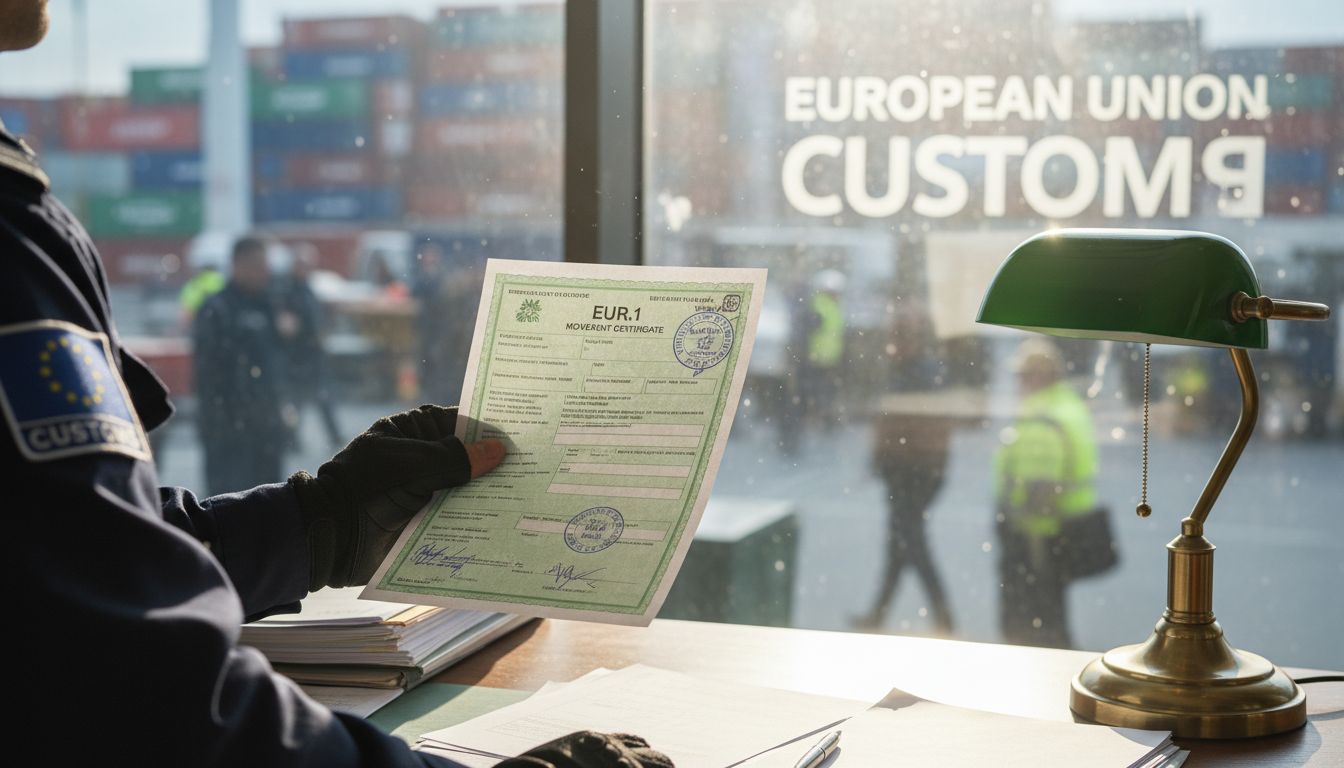
An EUR.1 movement certificate is a key document required to claim preferential tariff treatment for goods imported into the EU from certain beneficiary…
European commodity codes are essential for classifying goods imported into the EU.

EU businesses importing goods into the Union must lodge an entry summary declaration electronically before arrival, using the ecustoms declaration form.

Harmonized System (HS) codes are essential for classifying goods in the EU customs and trade framework.

For EU importers, correctly determining the HS code and tariff is essential for customs compliance and accurate duty payment.

EU import rules for goods originating in Russia impose extensive prohibitions and restrictions on a wide range of products, including iron, steel, diamonds…

An EORI number is a mandatory identification code for businesses importing goods into the EU.

FOB (Free On Board) and FCA (Free Carrier) are Incoterms that define different points of seller responsibility and risk transfer in container shipments.

The direct transport rule origin requires that goods benefiting from preferential origin under EU trade agreements must be transported directly between the…

ATA Carnet: Temporary Export Without Duties — a cited, EU-regulation-grounded guide to ata carnet for trade-compliance teams.

Discounts and rebates can affect the customs value of imported goods in the EU when they relate to the price actually paid or payable.

DAP and DPU are two Incoterms 2020 rules that define delivery points and unloading responsibilities differently.

Classifying textiles customs in the EU requires identifying the correct Combined Nomenclature (CN) code based on the textile product’s material composition…

EU businesses must convert customs values into the national currency of the Member State of importation using official exchange rates published monthly by…
EU tariff quotas regulate import duties by allowing a specific quantity of goods to enter the EU at a reduced or zero tariff rate.

Returned goods relief allows EU businesses to reclaim import duties on goods that are re-imported into the EU after being exported, provided specific…

The computed value method is a customs valuation technique used in specific cases where the transaction value cannot be determined or accepted.

EU tariff quotas regulate the volume of certain imports allowed at reduced or zero duty rates, with excess imports subject to higher duties.

Approved exporter status allows EU businesses that frequently export products under preferential trade agreements to self-certify the origin of their goods.

Section and chapter notes in the Harmonized System (HS) classification take precedence over the headings themselves when determining the correct…

The deductive value method is a customs valuation approach used in the EU when the transaction value of imported goods cannot be determined.
TARIC is the EU’s integrated tariff database that provides detailed information on customs duties and trade measures applicable to goods imported into the…

Outward processing relief (OPR) allows EU businesses to temporarily export goods for processing or repair outside the EU without paying import duties upon…

The primary difference between CIF and CFR Incoterms lies in the insurance obligation: CIF requires the seller to provide insurance for the goods during…

EU businesses importing or exporting parts and accessories must correctly classify these items according to the Harmonized System (HS) nomenclature and the…

Buying commissions are specifically excluded from the customs value of imported goods in the European Union.

TARIC additional codes are supplementary identifiers used alongside Combined Nomenclature (CN) codes to apply specific trade measures within the EU customs…

For EU businesses exporting under Pan-Euro-Mediterranean preferential rules of origin, the choice between a movement certificate EUR.1 and an origin…

Temporary admission is a customs procedure allowing certain goods to enter the EU temporarily without paying import duties or taxes, provided they are…

Classifying sets and kits in the Combined Nomenclature (CN) requires applying the General Rules of Interpretation (GRIs), identifying whether goods are put…

The first sale rule in EU customs valuation allows importers to declare customs value based on the price paid in the first sale within the EU, rather than…

The TARIC code structure consists of 10 digits: the first 8 digits correspond to the Combined Nomenclature (CN) code, while the final 2 digits represent…
EU importers must comply with a comprehensive ban on certain Russian goods that contribute to Russia’s military, industrial, and revenue-generating…

EU businesses operating within the single market must comply with the EU Russia export suspension list, which restricts exports of goods and technology that…

EU import VAT applies to businesses and individuals importing goods into the EU single market.

EU businesses importing goods into the EU single market must comply with preferential origin rules to benefit from reduced or zero customs duties.
EU importers of goods subject to the Carbon Border Adjustment Mechanism (CBAM) must obtain authorisation as CBAM declarants before importing into the EU…

EU importers must screen for specifically designated nationals and blocked persons to comply with EU sanctions regulations.

EU businesses exporting goods or technology to Russia must comply with extensive export restrictions under Regulation (EU) No 833/2014 and its subsequent…
EU businesses importing goods from Russia must comply with restrictive measures targeting entities on the Military-Industrial Complex List.

EU importers must screen their business partners against the EU sanctions lists, including those persons and entities designated under EU restrictive…

EU nationality and residency rules impose specific conditions on service providers operating within the EU single market, often requiring key personnel or…

EU businesses must comply with strict prohibitions on exporting certain goods and technology to Russia, including direct and indirect exports, as part of the…
EU importers must conduct embargo screening to ensure that goods entering the EU single market comply with applicable restrictive measures and do not pose…

EU companies involved in importing goods must conduct embargo compliance employee screening to ensure that personnel do not violate EU sanctions regulations.

EU businesses operating in the single market must comply with the designated nationals and blocked persons list by conducting due diligence and screening to…
EU import and export restrictions apply to all businesses trading goods within the EU single market and with third countries.

EU businesses involved in importing goods must conduct denied persons screening as part of the entry summary declaration process to identify consignments…

An EORI number is a unique identification number assigned to economic operators for customs purposes within the European Union.
EU import restrictions on Russian goods, as reflected in the russian embargo list, impose comprehensive prohibitions and controls on a wide range of…
EU businesses importing goods or services must comply with sanctions regimes against the Democratic People's Republic of Korea (DPRK) and Russia, including…

Import security risk analysis in the European Union (EU) requires businesses to submit an Entry Summary Declaration (ENS) ahead of goods arriving at the…

EU businesses importing goods must conduct sanctions screening as part of their compliance obligations.

EU businesses involved in importing goods must conduct restricted party screening to ensure compliance with EU trade regulations.
EU importers exceeding the single mass-based threshold for carbon-intensive goods must obtain authorised CBAM declarant status before continuing imports.

An EORI number is a unique identification number assigned to economic operators and other persons for customs purposes within the EU.

EU importers benefit from simplified preferential origin rules for small consignments, allowing preferential tariff treatment under specific conditions and…

An EU customs declarant is the person or entity responsible for submitting customs declarations and ensuring their accuracy and authenticity when goods enter…

Indirect customs representation involves a customs representative acting on behalf of a declarant but assuming limited liability, with the declarant…

In the European Union, import VAT liability generally falls on the person designated or recognised by the Member State where the goods are imported.

The import VAT taxable amount in the European Union is primarily based on the customs value of the imported goods, including certain additional costs and VAT…
In the EU customs framework, the customs debtor is the person liable for paying customs duties, typically the importer or the declarant who lodges the…
EU businesses importing goods can deduct inland transport costs incurred after the goods enter the EU customs territory from the customs value, provided they…

The place of introduction refers to the location within the EU customs territory where goods are first presented to customs authorities.
Freight and insurance costs incurred up to the EU border are generally added to the customs value of imported goods to ensure accurate duty calculation.
In EU trade, Delivered Duty Paid (DDP) means the seller handles customs clearance and pays all import duties and taxes, while Delivered at Place (DAP) places…
In the EU, customs valuation primarily follows the transaction value principle, meaning the customs value is based on the price actually paid or payable for…
Non-preferential origin refers to the general origin status of goods used for customs and trade statistics purposes within the EU and internationally…

Related party customs valuation rules apply to EU businesses importing goods from related parties.
EU customs warehousing allows businesses to store non-Union goods under customs control without paying import duties and VAT immediately.

Binding Tariff Information (BTI) is an official decision issued by the customs authorities of an EU Member State that provides a legally binding…

Inward processing allows EU businesses to suspend import duties on non-Union goods brought into the EU for processing and subsequent re-export.

Royalties and licence fees related to imported goods must be added to the customs value if they are a condition of sale and not already included in the price…

Union transit is a customs procedure that allows goods to move under duty suspension within the EU customs territory, simplifying trade by avoiding immediate…

Assists in customs valuation refer to goods or services provided directly or indirectly by the buyer free of charge or at a reduced cost for use in…

The Registered Exporter (REX) system is a database used to facilitate the application of preferential trade arrangements under the EU's Generalised Scheme of…

Simplified customs declarations allow authorised EU businesses to place goods under customs procedures with reduced data requirements and formalities.

The CN code structure is an 8-digit system used by EU businesses to classify goods for customs and statistical purposes.

The general rules interpretation of the Combined Nomenclature (CN) is governed primarily by Council Regulation (EEC) No 2658/87 and its implementing…
In the EU customs framework, the customs debtor is the person liable for the customs debt, which arises at the moment the customs declaration is accepted or…

An EORI number is a unique identification code assigned to economic operators importing or exporting goods within the EU customs territory.
EU importers must verify VAT numbers of their trading partners within the EU to ensure compliance with VAT rules and avoid risks such as missing trader…

In the context of EU import regulations, "specially designated nationals" refers to individuals or entities subject to specific restrictions or prohibitions…