Approved Exporter Status: Self-Certifying Origin in the EU
Quick answer
Approved exporter status allows EU businesses that frequently export products under preferential trade agreements to self-certify the origin of their goods. This status facilitates customs procedures by enabling exporters to issue origin declarations without prior customs approval for each shipment, subject to meeting specific guarantees and conditions set by customs authorities [1].
DCheck preferential origin — free, no sign-up to try.Key takeaways
- Approved exporter status permits self-certification of origin declarations or EUR-MED declarations for frequent exporters.
- The status is granted by the customs authorities of the exporting Member State upon satisfactory guarantees.
- Exporters must comply with conditions and maintain the guarantees to retain the status.
- Customs authorities monitor authorised exporters and may withdraw the status for misuse or non-compliance.
- Approved exporter status applies under various EU preferential trade agreements, including the Pan-Euro-Mediterranean Convention.
- The status is linked to a customs authorisation number that must appear on origin declarations.
- The scheme reduces administrative burdens and expedites customs clearance for qualifying exporters.
What is Approved Exporter Status?
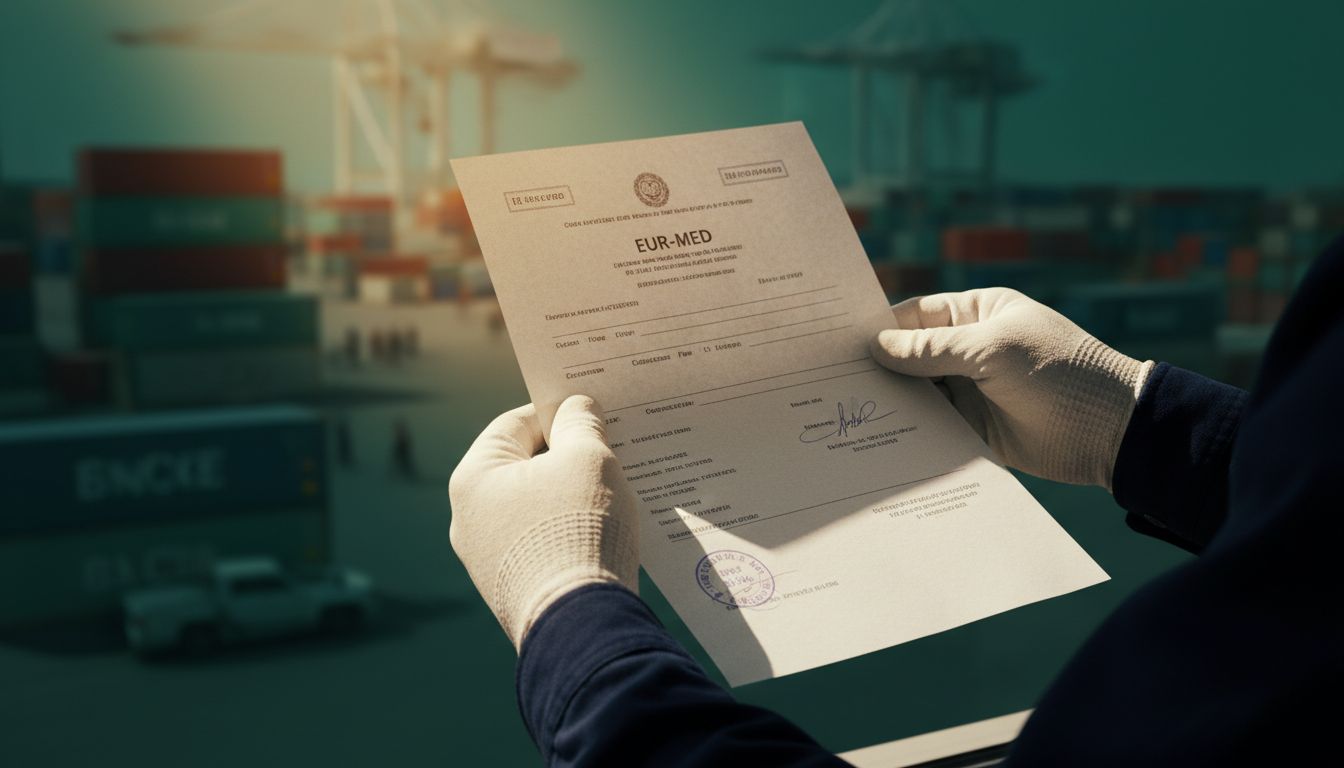
Approved exporter status is an authorisation granted by the customs authorities of an EU Member State to exporters who make frequent shipments of products under preferential trade agreements, such as the Pan-Euro-Mediterranean Convention [1:1]. This status enables exporters to self-certify the origin of their goods by issuing origin declarations or origin declarations EUR-MED without requiring customs authorities’ prior approval for each shipment, regardless of the shipment’s value [1:2].
In practice, this means that once authorised, an approved exporter can complete the origin declaration on commercial documents such as invoices or transport documents, facilitating smoother and faster customs clearance procedures. The customs authorities assign a unique customs authorisation number to the approved exporter, which must be included on all origin declarations issued by the exporter [1:3].
Approved exporter status is designed to simplify compliance with preferential rules of origin and to promote trade by reducing administrative burdens on frequent exporters within the EU single market and with partner countries under relevant trade agreements.
Who Can Apply for Approved Exporter Status?
Any exporter established within the EU who regularly ships products covered by a preferential trade agreement may apply for approved exporter status. The key criterion is that the exporter makes frequent shipments of originating products under the relevant Convention or Agreement [1:4].
Applicants must provide sufficient guarantees to the customs authorities to demonstrate their ability to verify the originating status of products and to comply with all applicable rules of origin and procedural requirements [1:5]. These guarantees typically include reliable internal control systems, accurate record-keeping, and the capacity to provide evidence supporting the origin declarations.
The customs authorities may impose additional conditions on the approved exporter depending on the nature of the goods, the trade agreement concerned, and the exporter’s compliance history [1:6]. Therefore, eligibility and the scope of authorisation may vary by Member State and by the specific trade agreement.
Benefits of Becoming an Approved Exporter
Obtaining approved exporter status offers several practical advantages for EU businesses engaged in preferential trade:
- Simplified Customs Procedures: Approved exporters can issue origin declarations themselves without requiring customs authorities’ prior approval for each shipment, expediting export operations [1:7].
- Cost Reduction: By reducing the need for customs intervention on every shipment, approved exporters save on administrative costs and delays.
- Increased Competitiveness: Faster customs clearance and reduced paperwork improve supply chain efficiency and customer satisfaction.
- Flexibility: Approved exporters may issue origin declarations irrespective of the shipment value, which is particularly beneficial for low-value consignments [1:8].
- Recognition Across Agreements: Approved exporter status is recognised under various EU preferential trade agreements, facilitating trade with multiple partner countries [1:9][2].
These benefits make approved exporter status a valuable compliance tool for frequent exporters seeking to optimise their customs and trade operations within the EU and with partner countries.
Application Requirements and Guarantees
To obtain approved exporter status, an exporter must submit an application to the customs authorities of the Member State where they are established. The application must include all necessary guarantees to satisfy customs authorities that the exporter can reliably verify the originating status of their products and comply with the applicable rules of origin [1:10].
These guarantees may include:
- Robust internal procedures for origin verification and record-keeping.
- Evidence of compliance with preferential trade agreement requirements.
- Demonstrated capacity to maintain and present documentation supporting origin declarations.
- Any additional conditions imposed by the customs authorities based on risk assessment or product type [1:11].
Once the customs authorities are satisfied with the guarantees, they grant the approved exporter status, issuing a customs authorisation number. This number must be included on all origin declarations or origin declarations EUR-MED issued by the exporter [1:12].
The customs authorities may also impose specific conditions on the approval, which the exporter must observe to maintain the status [1:13].
The Role of Customs Authorities
Customs authorities play a central role in the approved exporter status scheme:
- Assessment and Authorisation: They evaluate applications and grant the status if the exporter meets all requirements and provides satisfactory guarantees [1:14].
- Issuance of Authorisation Number: Customs assign a unique customs authorisation number to the approved exporter, which must be used on all origin declarations [1:15].
- Monitoring and Control: Authorities continuously monitor the use of the authorisation to ensure compliance with rules of origin and proper use of the status. This may include audits, checks, and verification of documentation [1:16].
- Enforcement: Customs may withdraw the approved exporter status if the exporter no longer offers the necessary guarantees, fails to comply with conditions, or misuses the authorisation [1:17].
The customs authorities’ oversight ensures the integrity of the preferential origin certification system and prevents fraud or errors that could undermine trade agreements.
Maintaining and Monitoring Approved Exporter Status
Once granted, approved exporter status requires ongoing compliance and cooperation with customs authorities:
- Exporters must maintain accurate records and documentation proving the originating status of their products.
- They must comply with any conditions imposed by the customs authorities at the time of authorisation.
- Customs authorities monitor the use of the authorisation through periodic checks or audits.
- Exporters should promptly inform customs of any changes that may affect their ability to comply with the guarantees provided.
Failure to maintain these standards may result in suspension or withdrawal of the approved exporter status [1:18].
Withdrawal of Approved Exporter Status
Customs authorities may withdraw approved exporter status at any time if:
- The exporter no longer provides the necessary guarantees to verify the originating status of products.
- The exporter fails to comply with conditions attached to the authorisation.
- There is incorrect or fraudulent use of the authorisation, such as issuing false origin declarations [1:19].
Withdrawal entails the loss of the right to self-certify origin declarations, requiring the exporter to revert to standard customs procedures for each shipment. This can lead to increased administrative burdens and potential delays.
Exporters facing withdrawal should engage with the relevant national competent authority to understand the grounds and explore remedies or re-application options.
FAQ
How do I get approved exporter status in the EU?
You must apply to the customs authorities of the Member State where you are established, demonstrating that you make frequent shipments under the relevant preferential trade agreement and providing guarantees to verify the originating status of your products. Upon satisfaction, customs will grant you the status and a customs authorisation number [1:20].
What are the advantages of approved exporter status for EU businesses?
The status allows self-certification of origin declarations without customs’ prior approval for each shipment, reducing administrative costs and delays, improving supply chain efficiency, and enabling origin declarations irrespective of shipment value [1:21].
Can an EU company self-certify origin for all shipments?
Only exporters authorised as approved exporters by customs authorities can self-certify origin declarations for shipments covered by the relevant preferential trade agreements. Others must obtain origin certification through standard customs procedures [1:22].
What is an origin declaration EUR-MED?
An origin declaration EUR-MED is a specific type of origin declaration used under the Pan-Euro-Mediterranean preferential rules of origin, allowing exporters to certify the originating status of goods in accordance with the Convention’s provisions [1:23].
What happens if an approved exporter misuses their authorisation?
Customs authorities may withdraw the approved exporter status if there is incorrect or fraudulent use of the authorisation, or if the exporter fails to maintain the required guarantees and conditions [1:24].
Is approved exporter status valid for all EU trade agreements?
Approved exporter status is granted under various EU preferential trade agreements, including the Pan-Euro-Mediterranean Convention and others. However, the exact scope and conditions may vary depending on the specific agreement and Member State implementation [1:25][2:1].
This article provides a general overview of approved exporter status in the EU. For specific cases, exporters should consult their national customs authorities or qualified legal counsel to ensure full compliance with applicable rules.
Sources
Could your goods qualify for a preferential rate?
The FTA & Origin Checker tells you whether an agreement covers your goods, which origin rule applies, and what proof you need to claim it.