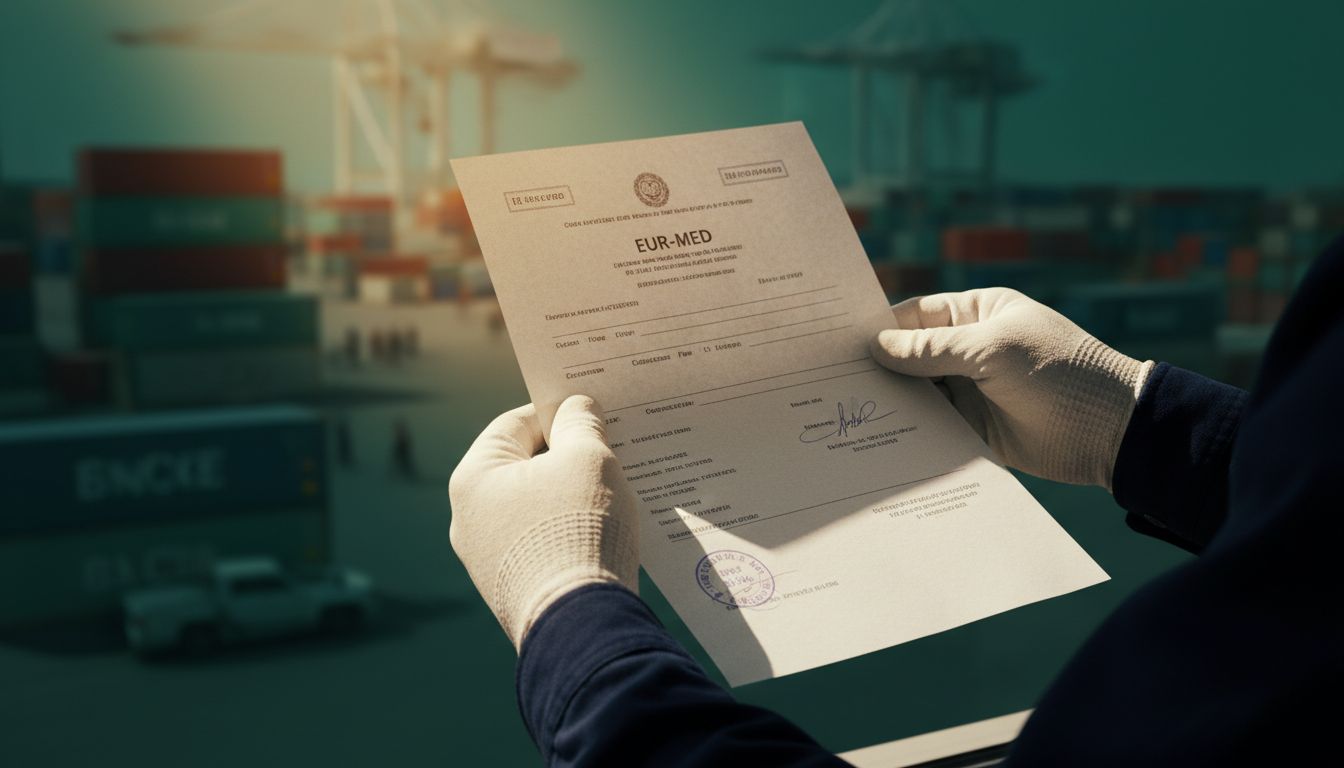
EUR.1 vs. Origin Declaration: Choosing Proof of Origin

Quick answer
For EU businesses exporting under Pan-Euro-Mediterranean preferential rules of origin, the choice between a movement certificate EUR.1 and an origin declaration depends primarily on the value of the consignment and whether the exporter is approved. EUR.1 certificates are issued by customs authorities and are generally required for consignments exceeding EUR 6,000, while origin declarations can be issued by approved exporters or for consignments below this threshold [1][2].
DCheck preferential origin — free, no sign-up to try.Key takeaways
- Proof of origin is essential for benefiting from preferential tariff treatment under Pan-Euro-Mediterranean agreements [3][4].
- A movement certificate EUR.1 is issued by customs authorities and is typically used for higher-value consignments [5][6].
- An origin declaration can be made out by approved exporters or for consignments not exceeding EUR 6,000 in value [1:1][2:1].
- EUR-MED documents relate to preferential rules involving Mediterranean countries and have specific conditions [1:2][2:2].
- Cumulation rules affect how origin is determined and which proofs are acceptable [1:3][5:1].
- EU exporters must comply with documentary and procedural obligations to maintain compliance and ensure smooth customs clearance [3:1][4:1].
Proof of Origin: The Foundation for Preferential Treatment
Proof of origin is the cornerstone for EU businesses seeking preferential tariff treatment when exporting goods under the Pan-Euro-Mediterranean preferential rules of origin. These rules enable products originating in one Contracting Party to benefit from reduced or zero customs duties upon importation into another Contracting Party, provided the exporter submits appropriate proof of origin. Without such proof, preferential tariffs cannot be applied, potentially increasing costs and reducing competitiveness within the EU single market and with partner countries [3:2][4:2].
The main accepted proofs of origin under these rules are the movement certificate EUR.1, the movement certificate EUR-MED, and the origin declaration (including the origin declaration EUR-MED). Each proof serves to certify that the goods meet the origin criteria set out in the relevant agreements and conventions, enabling preferential treatment [3:3][4:3].
What is a Movement Certificate EUR.1?
The movement certificate EUR.1 is a formal document issued by the customs authorities of an EU Member State or an eligible third country (such as Algeria) certifying that the goods concerned originate in the European Union or the issuing country. This certificate is used to claim preferential tariff treatment on importation into another Contracting Party under the Pan-Euro-Mediterranean rules of origin [5:2][6:1].
The EUR.1 certificate must be requested by the exporter and issued by the relevant customs authority before or at the time of export. It is typically required for consignments exceeding EUR 6,000 in value or in cases where the importer specifically requests it. The certificate contains detailed information about the goods, exporter, consignee, and origin criteria met, and must be presented to customs upon importation to benefit from preferential tariffs [5:3][6:2].
What is an Origin Declaration?
An origin declaration is a statement made by the exporter on an invoice, delivery note, or any other commercial document describing the products in sufficient detail to identify them. This declaration certifies that the goods comply with the origin criteria of the Pan-Euro-Mediterranean agreements and enables the importer to claim preferential tariff treatment [3:4][4:4][7].
Unlike the EUR.1 certificate, an origin declaration does not require issuance by customs authorities. Instead, it can be made out directly by the exporter, subject to certain conditions. The origin declaration is a simpler and more flexible proof of origin, often used for lower-value consignments or by exporters who have been granted approved exporter status [1:4][2:3].
When to Use an Origin Declaration: Value Thresholds and Approved Exporters
The key practical distinction in the eur1 vs origin declaration choice lies in the value of the consignment and the status of the exporter. According to Article 21 of the Regional Convention on Pan-Euro-Mediterranean preferential rules of origin:
- Any exporter may make out an origin declaration for consignments consisting of one or more packages containing originating products whose total value does not exceed EUR 6,000.
- Approved exporters, as defined under Article 22 of the Convention, may make out origin declarations regardless of the consignment value [1:5][8][2:4].
This means that for consignments valued at or below EUR 6,000, exporters can opt for the simpler origin declaration without involving customs authorities. For consignments exceeding this threshold, only approved exporters may issue origin declarations; otherwise, a movement certificate EUR.1 must be obtained from customs [1:6][2:5].
Approved exporter status is granted by the competent national authority of the Member State and requires the exporter to meet certain reliability and compliance criteria. This status facilitates trade by allowing exporters to self-certify origin, reducing administrative burdens and speeding up customs procedures [1:7].
Understanding EUR-MED Documents
EUR-MED documents, including the movement certificate EUR-MED and the origin declaration EUR-MED, apply within the Pan-Euro-Mediterranean system, which extends preferential rules of origin to Mediterranean partner countries. These documents are similar in function to the EUR.1 certificate and origin declaration but incorporate specific rules related to cumulation and origin criteria involving Mediterranean countries [1:8][2:6].
The EUR-MED certificate or declaration is required when the goods originate in or are exported from countries listed in Article 3(2) of the Convention, which includes Mediterranean partners. In such cases, the EUR-MED documents ensure that preferential treatment is correctly applied, reflecting the specific origin and cumulation rules applicable to these countries [1:9][2:7].
Cumulation and Proof of Origin
Cumulation is a mechanism that allows materials originating in one Contracting Party to be considered as originating materials when incorporated into products in another Contracting Party. This facilitates regional production and trade by broadening the scope of origin criteria [1:10][5:4].
The application of cumulation affects which proof of origin documents can be used. For example, an origin declaration may be accepted if the products originate in a Contracting Party with which cumulation applies, provided that any non-originating materials meet the required conditions. Where cumulation involves Mediterranean countries, EUR-MED documents are necessary to reflect the cumulation rules correctly [1:11][2:8][5:5].
Understanding the interplay between cumulation and proof of origin is crucial for exporters to ensure compliance and to select the appropriate document—EUR.1, EUR-MED, or origin declaration—based on the origin status of the goods and the countries involved [1:12][5:6].
Obligations for EU Exporters
EU exporters operating within the Pan-Euro-Mediterranean framework must adhere to several obligations to maintain compliance:
- Ensure that products meet the origin criteria as defined in the Convention and relevant agreements.
- Choose the correct proof of origin—either a movement certificate EUR.1, EUR-MED, or an origin declaration—based on consignment value and exporter status.
- Obtain approved exporter status from the relevant national competent authority if intending to issue origin declarations for consignments exceeding EUR 6,000.
- Maintain adequate records and documentation to substantiate origin claims in case of customs audits or verifications.
- Submit the movement certificate EUR.1 to customs authorities for issuance when required and ensure accurate completion of all documentary requirements.
- Understand and apply cumulation rules correctly to benefit from preferential treatment without risking non-compliance [1:13][2:9][3:5][4:5].
Failure to comply with these obligations can result in the denial of preferential tariff treatment, delays in customs clearance, and potential penalties. Therefore, exporters should establish robust internal compliance procedures and liaise with their national competent authorities for guidance.
FAQ
What is the difference between EUR.1 and origin declaration?
The EUR.1 is a movement certificate issued by customs authorities certifying the origin of goods, typically required for consignments over EUR 6,000 or when requested by the importer. An origin declaration is a statement made by the exporter on commercial documents certifying origin, usable for consignments up to EUR 6,000 or by approved exporters regardless of value [1:14][2:10][5:7].
When do I need an EUR.1 certificate?
You need an EUR.1 certificate when exporting originating products with a consignment value exceeding EUR 6,000, unless you are an approved exporter authorized to issue origin declarations. Also, if the importer requests it, an EUR.1 may be necessary [1:15][2:11].
Can any exporter issue an origin declaration?
Any exporter can issue an origin declaration for consignments not exceeding EUR 6,000 in value. For consignments above this threshold, only exporters with approved exporter status may issue origin declarations [1:16][2:12].
What is the value limit for an origin declaration?
The value limit for consignments covered by an origin declaration issued by any exporter is EUR 6,000. Above this, only approved exporters may issue origin declarations; otherwise, a movement certificate EUR.1 is required [1:17][2:13].
What is an approved exporter status for origin declarations?
Approved exporter status is a certification granted by the competent national authority allowing an exporter to issue origin declarations for consignments exceeding EUR 6,000 without needing to obtain an EUR.1 certificate from customs [1:18].
What is an EUR-MED certificate?
An EUR-MED certificate is a movement certificate used under the Pan-Euro-Mediterranean system for goods originating in or exported from Mediterranean partner countries. It certifies origin under specific cumulation and origin rules applicable to these countries [1:19][2:14].
How does cumulation affect proof of origin documents?
Cumulation allows materials from one Contracting Party to be treated as originating when used in another Contracting Party. This affects which proof of origin documents are valid, often requiring EUR-MED certificates or declarations to reflect the cumulation arrangements accurately [1:20][5:8].
This article aims to clarify the practical distinctions and obligations for EU businesses when choosing between EUR.1 and origin declarations as proofs of origin under the Pan-Euro-Mediterranean preferential rules. For specific cases and detailed legal interpretations, consulting qualified legal counsel or the relevant national competent authority is recommended.
Sources
Could your goods qualify for a preferential rate?
The FTA & Origin Checker tells you whether an agreement covers your goods, which origin rule applies, and what proof you need to claim it.