EUR-MED Certificates: Proving Origin for Pan-Euro-Med Trade
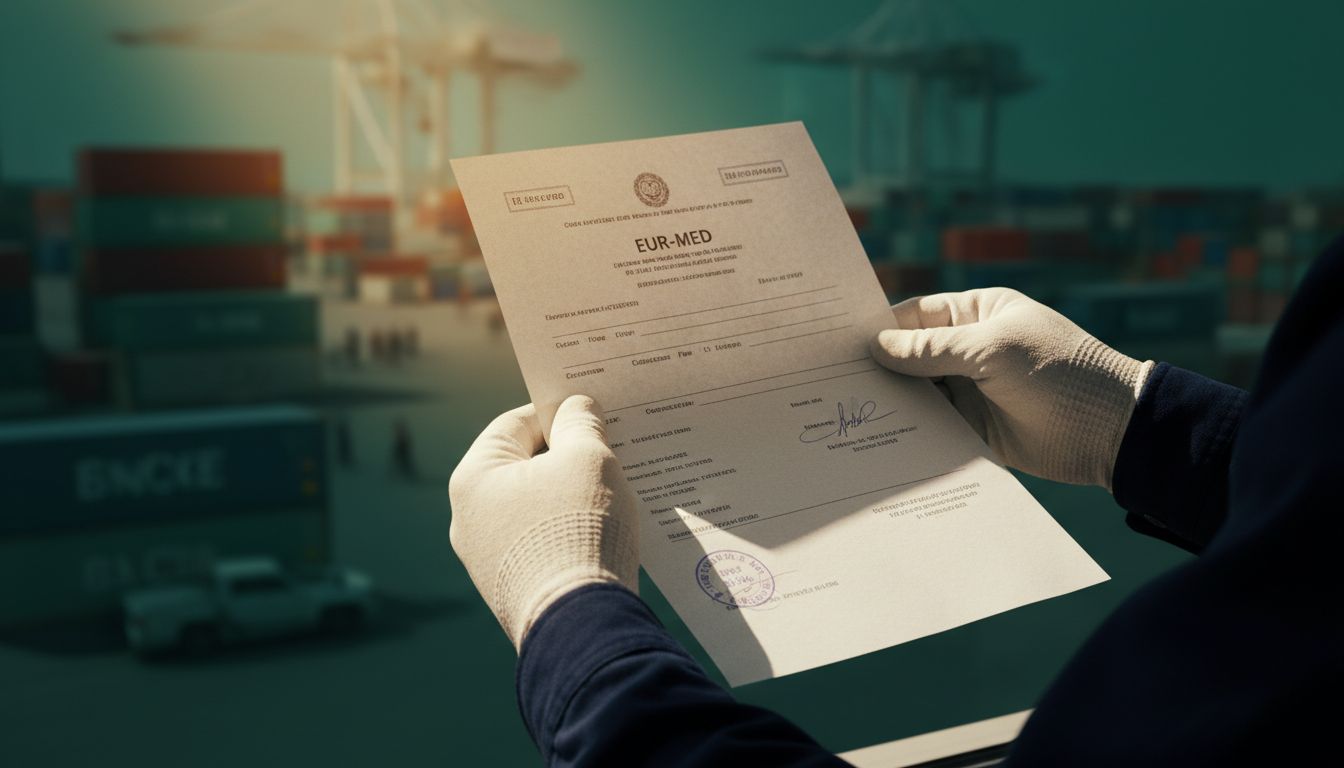
Quick answer
The EUR-MED certificate is a key document used by businesses within the Pan-Euro-Med Convention area to prove the preferential origin of goods. It enables EU companies to benefit from tariff reductions or exemptions when trading with partner countries under the Pan-Euro-Med system.
DCheck preferential origin — free, no sign-up to try.Key takeaways
- The EUR-MED certificate confirms that goods meet the rules of origin under the Pan-Euro-Med Convention.
- It applies to exporters and importers operating within the EU and partner countries covered by the Convention.
- Using EUR-MED certificates facilitates preferential tariff treatment across a wide network of countries.
- Issuance requires compliance with specific origin criteria and submission to the relevant national competent authority.
- Proper record-keeping and compliance are essential to maintain eligibility and avoid penalties.
- EUR-MED certificates differ from other certificates of origin such as EUR.1 or origin declarations, although they serve related purposes.
What is a EUR-MED Certificate and its Purpose?
The EUR-MED certificate is an official document used to certify that goods exported from one country to another within the Pan-Euro-Med Convention area comply with the preferential rules of origin established by the Convention. This certificate serves as proof that the goods are “originating products” under the Convention’s rules, which entitles them to preferential tariff treatment when imported into partner countries.
The Pan-Euro-Med Convention is a multilateral agreement that harmonises and simplifies the rules of origin among its members, which include the European Union and several Mediterranean partner countries. By using the EUR-MED certificate, businesses can demonstrate that their products meet the required origin criteria, facilitating reduced or zero customs duties and smoother customs procedures.
In practice, the EUR-MED certificate supports EU businesses in asserting the preferential origin of their goods, thereby enhancing competitiveness in international trade within the Pan-Euro-Med network. It is a vital compliance tool for companies seeking to optimise their supply chains and benefit from trade agreements under the Convention.
Who Needs a EUR-MED Certificate?
The EUR-MED certificate is relevant for any EU-based company that exports goods to countries participating in the Pan-Euro-Med Convention and wishes to claim preferential tariff treatment. This includes manufacturers, exporters, and authorised exporters who must prove that their goods meet the Convention’s rules of origin.
Importers in the EU may also require the EUR-MED certificate to present to customs authorities to benefit from preferential tariffs upon importation. Furthermore, customs authorities in the EU Member States are responsible for verifying the authenticity and validity of EUR-MED certificates presented during customs clearance.
The obligation to obtain and present a EUR-MED certificate applies primarily to businesses involved in cross-border trade within the Pan-Euro-Med area. Companies trading outside this network or not seeking preferential treatment generally do not need this certificate.
Benefits of Using EUR-MED Certificates for EU Businesses
Utilising EUR-MED certificates offers several advantages for EU businesses engaged in international trade within the Pan-Euro-Med region:
- Preferential Tariff Access: The certificate enables companies to benefit from reduced or zero customs duties, lowering the cost of goods sold and improving market competitiveness.
- Simplified Customs Procedures: Customs authorities recognise the EUR-MED certificate as proof of origin, which can expedite customs clearance and reduce administrative burdens.
- Supply Chain Flexibility: The Pan-Euro-Med rules allow cumulation of origin among member countries, meaning materials sourced from any member can contribute to the originating status of the final product. This flexibility supports efficient sourcing and manufacturing strategies.
- Legal Certainty: The EUR-MED certificate provides formal evidence accepted by customs authorities across the Convention area, reducing the risk of disputes or delays related to origin verification.
- Market Access: By demonstrating compliance with origin rules, EU businesses can access preferential trade terms in multiple countries, expanding export opportunities.
Overall, the EUR-MED certificate is a strategic compliance instrument that supports cost savings and operational efficiency for EU companies trading within the Pan-Euro-Med framework.
How to Obtain a EUR-MED Certificate
To obtain a EUR-MED certificate, an EU exporter must follow these steps:
-
Determine Eligibility: Confirm that the goods meet the Pan-Euro-Med rules of origin. This involves verifying that the product qualifies as originating under the Convention’s criteria, which may include specific manufacturing or processing requirements.
-
Prepare Documentation: Gather all necessary supporting documents demonstrating compliance with origin rules, such as production records, supplier declarations, and invoices.
-
Submit Application: Apply for the EUR-MED certificate through the competent authority in the EU Member State where the exporter is established. This authority is typically a customs office or a designated issuing body.
-
Certification: The competent authority reviews the application and supporting evidence. If satisfied, it issues the EUR-MED certificate, which must accompany the goods during export.
-
Presentation at Import: The importer presents the EUR-MED certificate to customs in the destination country to claim preferential tariff treatment.
It is crucial for exporters to ensure accuracy and completeness in the application to avoid delays or refusals. Some Member States may offer electronic systems for issuing EUR-MED certificates, streamlining the process.
Key Information Required for Issuance
When applying for a EUR-MED certificate, the following information is typically required:
- Exporter Details: Name, address, and EORI number of the exporter established within the EU.
- Consignee Details: Name and address of the recipient outside the EU.
- Description of Goods: Precise description, including tariff classification (HS code) and quantity.
- Origin Criteria: Evidence supporting the goods’ originating status under the Pan-Euro-Med rules, such as manufacturing processes or materials used.
- Transport Details: Mode of transport and route, if relevant.
- Declaration: A statement by the exporter or authorised representative certifying the truthfulness of the information provided.
The competent authority may require additional documentation or verification depending on the Member State’s procedures. Maintaining accurate records supporting the certificate’s issuance is essential for compliance and potential audits. Exporters who still need to register for an EORI number can consult our EORI number guide by country for the requirements in each EU Member State.
Maintaining Compliance and Record-Keeping
EU businesses using EUR-MED certificates must maintain comprehensive records to demonstrate ongoing compliance with origin rules. This includes:
- Copies of issued EUR-MED certificates.
- Supporting documents such as production records, supplier declarations, and invoices.
- Evidence of compliance with manufacturing or processing criteria.
- Records of shipments and customs declarations.
These documents should be retained for a period specified by national legislation, often several years, to allow customs authorities to verify origin claims if requested.
Failure to maintain adequate records or to comply with origin rules may result in penalties, rejection of preferential treatment, or repayment of duties. Therefore, companies should implement robust internal controls and training to ensure compliance.
Distinguishing EUR-MED from Other Proofs of Origin
It is important to differentiate the EUR-MED certificate from other documents used to prove origin in international trade:
- EUR.1 Certificate: The EUR.1 is a certificate of origin used under specific bilateral trade agreements (e.g., EU-UK trade) to claim preferential tariffs. While similar in function, the EUR.1 applies to different agreements and rules than the Pan-Euro-Med Convention.
- Origin Declaration Statement: This is a statement made by the exporter on the invoice or another commercial document certifying the origin of the goods. It is often used for low-value shipments or simplified procedures but may not replace a EUR-MED certificate where required.
- Certificates of Origin: These are general documents issued by chambers of commerce or other bodies certifying the origin of goods but may not confer preferential treatment unless aligned with specific trade agreements.
The EUR-MED certificate specifically relates to the Pan-Euro-Med Convention and its multilateral rules of origin, making it distinct in scope and application.
FAQ
What is an EUR1 certificate?
An EUR1 certificate is a document used to prove the preferential origin of goods under certain bilateral or regional trade agreements involving the EU. It enables exporters to claim reduced or zero customs duties when exporting to partner countries. It differs from the EUR-MED certificate, which applies under the Pan-Euro-Med Convention [1].
How to get EUR1 certificate?
To obtain an EUR1 certificate, exporters must apply to the relevant national competent authority in their Member State, providing evidence that their goods meet the origin criteria of the applicable trade agreement. The authority verifies the information and issues the certificate if conditions are met [1:1].
Can the UK issue EUR1?
Post-Brexit, the UK can issue EUR1 certificates for exports to countries with which it has bilateral trade agreements. However, the UK’s ability to issue EUR1 certificates depends on the specific agreements in place and their rules of origin. EU Member States continue to issue EUR1 certificates for their exporters under EU agreements [1:2].
What is the EUR1 declaration statement?
The EUR1 declaration statement is a declaration made by the exporter on an invoice or other commercial document certifying that the goods meet the origin criteria for preferential treatment under a relevant trade agreement. It may be used as an alternative to the EUR1 certificate in certain cases, subject to conditions set by the agreement [1:3].
This article provides an overview of the EUR-MED certificate’s role in Pan-Euro-Med trade. EU businesses should consult the relevant national competent authority or qualified legal counsel to ensure compliance with specific procedural and regulatory requirements applicable in their Member State.
Sources
Could your goods qualify for a preferential rate?
The FTA & Origin Checker tells you whether an agreement covers your goods, which origin rule applies, and what proof you need to claim it.