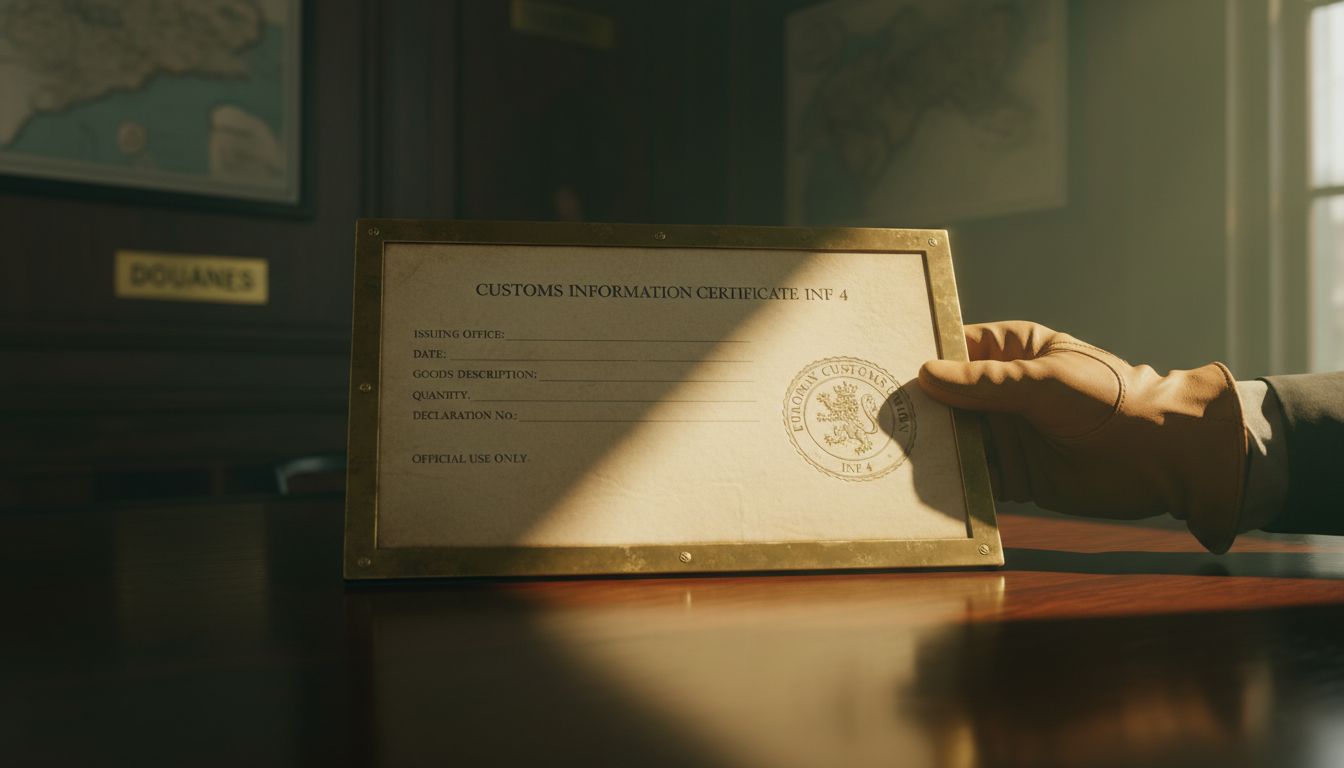
EU Import Forms: INF 4, Export Authorisations, and Airworthiness

Quick answer
EU businesses importing or exporting goods must use specific forms such as the INF 4 certificate to prove preferential origin, export authorisation forms for controlled goods, and airworthiness certificates for aircraft and aviation products. These forms ensure compliance with EU customs and trade regulations and must be completed accurately, in the required language, and submitted to the relevant national authorities.
DAsk the AI Customs Broker — free, no sign-up to try.Key takeaways
- INF 4 certificates are used by EU importers to establish preferential origin of goods for customs purposes.
- Export authorisation forms are mandatory for certain restricted goods, including dual-use items, and are valid across all EU Member States.
- Airworthiness forms (EASA Form 52, EASA Form 1) are required for exporting or importing new and used aircraft and aviation products within the EU.
- All EU customs forms must be completed in an official EU language, with possible translation requests by national customs authorities.
- Special forms and declarations apply to returned goods and imports subject to anti-dumping duties.
- The phrase “form bol” appears in customs and transport documentation contexts but is not a specific EU customs form.
Who Needs to Use EU Import and Export Forms?
EU companies involved in the import or export of goods must comply with a range of customs documentation requirements. This includes importers bringing goods into the EU customs territory and exporters sending goods out of the EU. The obligations apply regardless of the goods’ origin or destination, but specific forms depend on the nature of the goods and the trade regime applied.
For preferential trade regimes, importers require certificates such as the INF 4 to prove the preferential origin of goods, enabling reduced or zero customs duties. Exporters of restricted goods, including dual-use items or goods subject to sanctions, must obtain export authorisations valid across all EU Member States. Businesses dealing with aircraft or aviation products must use airworthiness certificates issued or recognised by the European Union Aviation Safety Agency (EASA).
The relevant national customs authority in the Member State where the goods enter or leave the customs territory oversees compliance and form issuance. Companies must ensure they hold an Economic Operators Registration and Identification (EORI) number to interact with customs authorities and submit declarations electronically or on paper as required.
Information Certificate INF 4: Proving Preferential Origin
The INF 4 certificate is an information document used to facilitate the establishment of the preferential origin of goods imported into the EU. It is issued by the supplier outside the EU to support the preferential treatment of goods under trade agreements or autonomous preferential arrangements.
The form must be printed on white paper, sized 210 × 297 mm, and bear a unique serial number. It is completed in one of the official EU languages and includes detailed information such as the supplier and consignee names and addresses, invoice numbers, description and quantity of goods, and a supplier declaration certifying the originating status of the goods [1][2].
The supplier’s declaration confirms that the goods meet the required conditions for preferential origin and that supporting documents (e.g., invoices, movement certificates, manufacturers’ declarations) are available upon request by customs authorities. The INF 4 certificate must be free of erasures or overwriting; any corrections must be initialled and endorsed by customs authorities [2:1].
In practice, EU importers should request the INF 4 from their suppliers when preferential origin is claimed. This form supports customs declarations and helps avoid delays or additional duties. The INF 4 is particularly relevant when the goods’ value exceeds thresholds requiring proof of origin or when customs authorities request documentary evidence.
Export Authorisation Forms for Restricted Goods
Certain goods exported from the EU require prior authorisation due to their nature or destination. These include dual-use items, military-related goods, and goods subject to EU restrictive measures such as sanctions.
Export authorisation forms are standardised and valid throughout the EU. The forms collect detailed information about the exporter, consignee, end user, description of goods, country of origin, commodity codes, quantities, and intended use. The authorisation confirms compliance with EU export control regulations and sanctions regimes [3][4].
For example, Regulation (EU) 2022/328 provides a model export authorisation form for restricted goods. This form includes fields for the exporter’s identification, contact details, consignee, issuing authority, and end-use confirmation. The authorisation is issued by the competent national authority and is valid until its expiry date across all Member States [3:1].
Exporters of dual-use goods must apply to the relevant national competent authority for an export authorisation before shipment. The application must include detailed descriptions and codes of the goods, the end user, and the intended end use. Export authorisations may contain conditions or restrictions depending on the nature of the goods and risk assessments.
EU businesses must ensure that export authorisation forms are correctly completed and submitted in advance of export. Failure to obtain required authorisations can result in penalties, shipment delays, or refusal of export clearance.
Airworthiness Forms for Aircraft and Aviation Products
The export and import of aircraft and aviation products within the EU require specific airworthiness forms issued or recognised by the European Union Aviation Safety Agency (EASA). These forms certify that the aircraft or parts comply with safety and regulatory standards.
For new aircraft, the EASA Form 52 is used as an export document certifying airworthiness. Used aircraft require an export certificate of airworthiness. Other new aviation products are accompanied by EASA Form 1, which certifies conformity with design and production requirements [5].
These forms are essential for customs clearance and regulatory compliance when aircraft or aviation products cross EU borders. They provide assurance to customs and aviation authorities that the products meet safety standards and are authorised for operation or further processing.
EU businesses involved in the aviation sector should coordinate with EASA and the relevant national competent authorities to obtain and complete the correct airworthiness forms. This process includes ensuring that all technical and regulatory documentation is in order and that forms are signed and stamped by authorised officials [5:1].
General Requirements for Form Completion and Language
All EU customs and trade forms, including INF 4, export authorisations, and airworthiness certificates, must be completed in one of the official languages of the European Union. The form must be printed and filled out in the same language, and no erasures or overwriting are allowed. Any corrections must be initialled and endorsed by the issuing authority or customs [1:1][2:2].
The customs authorities of the Member State where the form is submitted may require a translation of the form into the official language or languages of that Member State. This ensures that customs officials can verify the information accurately and efficiently.
Forms must be printed on appropriate paper, typically white, free of mechanical pulp, and sized according to EU specifications (210 × 297 mm with specific weight and layout requirements). Each form carries a unique serial number for traceability and authenticity [6][2:3].
In practice, EU businesses should verify the language requirements and ensure that forms are completed legibly and accurately. They should also prepare to provide translations if requested by the customs office. This applies to all forms, including the “form bol,” which is a term sometimes used in logistics and transport documentation but must comply with these general rules when submitted to customs.
Special Cases: Returned Goods and Anti-Dumping Declarations
Returned goods to the EU are subject to specific documentation requirements to ensure they are not subject to unnecessary customs duties. The INF 3 information sheet is used for returned goods, providing details about the shipment and confirming that the goods meet the conditions for duty relief [6:1].
The INF 3 form follows similar printing and language rules as other customs forms and must be presented to customs authorities upon re-importation.
For imports subject to anti-dumping duties, manufacturers or exporters may need to provide a manufacturer declaration. This declaration certifies the origin and production details of the goods and is signed by an authorised official of the manufacturing entity. For example, Commission Implementing Regulation (EU) 2024/1268 sets out the format and content of such declarations for stainless steel cold-rolled flat products originating from certain countries [7].
The manufacturer declaration typically appears on the commercial invoice and must include the name and function of the official, a certification statement regarding the goods, and the date and signature. This supports customs authorities in applying the correct anti-dumping duties and verifying compliance with EU trade defence measures.
EU businesses importing goods subject to anti-dumping duties should ensure that manufacturer declarations are obtained and included with customs documentation. This helps avoid delays and ensures correct duty assessment.
Next steps
- Confirm the commodity code and origin of your goods to determine if an INF 4 certificate is required.
- Request the INF 4 certificate from your supplier or prepare to issue it if you are the exporter.
- Identify if your goods require export authorisation under EU regulations and apply to the relevant national authority.
- For aircraft or aviation products, obtain the appropriate EASA airworthiness forms before export or import.
- Complete all forms in an official EU language and prepare translations if requested by customs authorities.
FAQ
What is an INF 4 certificate used for in the EU?
The INF 4 certificate is used to establish the preferential origin of goods imported into the EU, facilitating reduced customs duties under trade agreements or preferential schemes [1:2][2:4].
How do I get an export authorisation for dual-use goods in the EU?
Exporters must apply to the relevant national competent authority using the standard EU export authorisation form, providing detailed information about the goods, end user, and intended use. The authorisation is valid across all Member States until expiry [3:2][4:1].
What forms are needed for importing aircraft into the EU?
Imports of new aircraft require EASA Form 52, used aircraft require an export certificate of airworthiness, and other aviation products require EASA Form 1, certifying conformity with safety standards [5:2].
Can I complete EU customs forms in any language?
Forms must be completed in one of the official languages of the EU. Customs authorities in the Member State where the form is submitted may request a translation into their official language(s) [1:3][2:5].
What is a manufacturer declaration for anti-dumping duties?
It is a signed statement by an official of the manufacturer certifying the origin and production details of goods subject to anti-dumping duties, included with the commercial invoice to support customs duty assessment [7:1].
Sources
Still need the answer for your own shipment?
Ask the AI Customs Broker. It classifies, values and clears your goods against the live EU rules, and cites the regulation behind every answer.