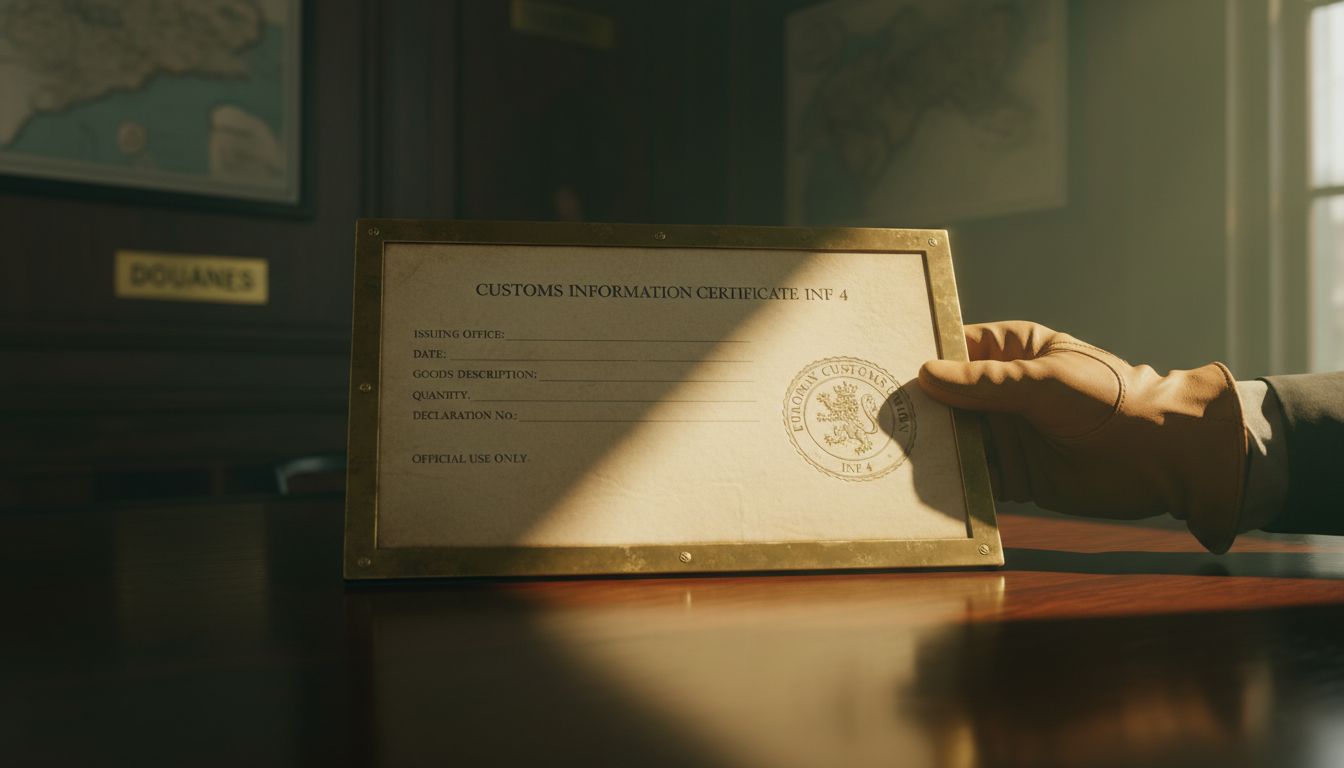
Completing EU Customs Information Certificate INF 4
Quick answer
The Information Certificate INF 4 is an official document used to establish the preferential origin of goods entering the EU. EU businesses needing to prove preferential origin must complete and submit the INF 4 form accurately, following specific formatting and content rules to ensure customs acceptance and compliance [1].
DAsk the AI Customs Broker — free, no sign-up to try.Key takeaways
- The INF 4 certificate facilitates proving preferential origin of goods within the EU customs framework [1:1].
- The form must be printed on white paper, sized 210 × 297 mm, and bear a unique serial number [1:2].
- Completion requires supplier and consignee details, invoice references, detailed goods description, gross mass, and supplier declaration [1:3][2].
- The form must be completed in an official EU language and may require translation by customs authorities [2:1].
- Customs endorsement is mandatory to validate the certificate [1:4].
- Businesses must maintain all supporting documents and declarations related to the INF 4 for verification purposes [2:2].
- Using an editable CN22 form to prepare the INF 4 can facilitate accurate data entry and compliance.
What is an Information Certificate INF 4?
The Information Certificate INF 4 is a formal document issued to facilitate the establishment of the preferential origin of goods imported into the European Union. It is used primarily to support customs procedures by certifying that the goods meet the criteria for preferential treatment under EU trade agreements. This certificate helps businesses and customs authorities verify that goods qualify for reduced or zero customs duties based on their origin [1:5].
The INF 4 serves as evidence that the supplier’s declaration regarding the originating status of the goods is accurate. It is part of the documentation required under the Union Customs Code and its implementing regulations, ensuring transparency and compliance in preferential trade [1:6].
Who Needs to Use the INF 4 Form?
The INF 4 form is relevant to EU businesses involved in importing or trading goods that benefit from preferential tariff treatment. This includes:
- Importers seeking to claim preferential duty rates based on the origin of goods.
- Suppliers or exporters who must certify the originating status of their goods.
- Customs authorities requiring proof of preferential origin for customs clearance.
In practice, any EU company that imports goods under preferential trade agreements or requires proof of origin for customs valuation should use the INF 4 form. The supplier or their authorised representative is responsible for completing and submitting the form [1:7][2:3].
Key Information Required on the INF 4
Completing the INF 4 form requires precise and comprehensive information to satisfy customs requirements:
- Supplier Details: Full name, address, and country of the supplier issuing the certificate [1:8].
- Consignee Details: Full name, address, and country of the recipient of the goods [1:9].
- Invoice Numbers: Reference numbers of invoices, delivery notes, or other commercial documents related to the shipment. This box may be left blank for long-term declarations [1:10][2:4].
- Observations: Any additional remarks or relevant information concerning the shipment [1:11].
- Item Description: Detailed description of the goods, including item number, marks and numbers, number and kind of packages, and sufficient detail to identify the goods according to commercial practice [1:12][2:5].
- Gross Mass or Other Measure: Weight in kilograms or other applicable measures such as litres or cubic metres [1:13].
- Customs Endorsement: The customs authority’s stamp and signature validating the certificate [1:14].
- Declaration by the Supplier: A statement certifying the correctness of the declaration concerning the originating status of the goods, signed and dated by the supplier [1:15][2:6].
Each of these fields must be completed accurately to avoid delays or rejection by customs authorities.
How to Complete the INF 4 Form Accurately
To ensure the INF 4 form is accepted by customs authorities, EU businesses should follow these best practices:
- Use an editable CN22 form template or the official INF 4 form to enter data clearly and correctly. This reduces errors and facilitates re-use for multiple shipments [1:16].
- Complete the form in one of the official languages of the European Union. Customs authorities may request a translation into their official language if necessary [2:7].
- Avoid erasures or overwriting. Any corrections must be made by deleting incorrect information, adding the correct data, and initialling the changes. Customs authorities must endorse such alterations [1:17].
- Do not leave blank spaces between items. Each item must be numbered, and a horizontal line should be drawn below the last entry. Strike through any unused space to prevent later additions [1:18].
- Describe goods in sufficient detail to enable identification, following commercial practice. This includes marks, numbers, packaging, and precise descriptions [1:19].
- Ensure the supplier’s declaration is signed, dated, and includes the issuing country and place [1:20][2:8].
Using an editable CN22 form can help streamline these steps by providing a structured digital template that meets the formatting requirements and reduces manual errors.
Printing and Formatting Requirements
The INF 4 form must comply with strict printing and formatting standards established by the EU:
- The form must be printed on white paper, free of mechanical pulp, suitable for writing, weighing between 40 and 65 grams per square metre [1:21].
- The dimensions of the form are 210 × 297 mm (A4 size), with a tolerance of minus 5 mm or plus 8 mm in length allowed [1:22].
- Printing responsibility lies with the Member States, which must ensure each form bears a unique serial number for identification [1:23].
- The form must be printed in one of the official languages of the European Union [1:24].
- The layout and content boxes must be strictly observed to maintain uniformity and facilitate customs processing [1:25].
Businesses should ensure that any printed or digitally prepared INF 4 forms meet these specifications before submission. Using an editable CN22 form adapted to these standards can assist in maintaining compliance.
Customs Endorsement and Supplier Declaration
A critical step in the INF 4 process is obtaining customs endorsement. This endorsement confirms that customs authorities have verified the certificate and accept the supplier’s declaration of preferential origin.
- The customs endorsement box must be completed with the customs office stamp, signature, place, and date [1:26].
- The supplier declaration certifies that the information on the form and attached invoices or long-term declarations is correct. The supplier must sign and date this section, indicating the issuing country and place [1:27][2:9].
- The supplier’s declaration includes a choice to confirm whether the declaration is correct or not, marked by placing a cross in the appropriate box [1:28].
Without proper customs endorsement and a signed supplier declaration, the INF 4 certificate is not valid for preferential origin claims.
Maintaining Records and Supporting Documents
EU businesses must retain all documentation supporting the INF 4 certificate for verification by customs authorities:
- Supporting documents may include import documents, movement certificates, invoices, manufacturers’ declarations, or other evidence demonstrating the origin of the goods [2:10].
- The supplier undertakes to provide these supporting documents upon request by the relevant authorities and to allow inspections of accounts or manufacturing processes if required [2:11].
- Accurate record-keeping ensures compliance with the Union Customs Code and facilitates audits or checks by customs officials.
Maintaining these records alongside the INF 4 certificate helps businesses demonstrate compliance and avoid penalties or delays.
FAQ
Can I print the CN22 form?
Yes. The CN22 form, including the INF 4 certificate, must be printed on white paper sized 210 × 297 mm, weighing between 40 and 65 grams per square metre, and in one of the official EU languages. Printing is typically the responsibility of Member States, but businesses preparing the form should ensure compliance with these standards [1:29].
How do I complete the CN22 customs form?
Complete the CN22 form by entering supplier and consignee details, invoice numbers, detailed descriptions of goods, gross mass or volume, and the supplier’s declaration. Use clear language, avoid erasures, number each item, and ensure the form is signed and dated. Customs endorsement is also required for validity [1:30][2:12].
Can I get a CN22 form from the post office?
The INF 4 certificate is a specific customs document distinct from the standard CN22 customs declaration form used for postal shipments. While postal CN22 forms are generally available at post offices, the INF 4 form is issued or printed under the responsibility of Member States’ customs authorities and is not typically available from post offices [1:31].
Can I make my own customs declaration?
Suppliers or their authorised representatives may complete the INF 4 form themselves, certifying the origin of goods. However, the form must be correctly completed, signed, and endorsed by customs authorities to be valid. Any inaccurate information can lead to penalties [1:32][3].
Next steps
- Obtain an editable CN22 form template compliant with INF 4 specifications to facilitate accurate data entry.
- Collect all necessary information: supplier and consignee details, invoice references, detailed goods description, and gross mass.
- Complete the INF 4 form in an official EU language, ensuring no blank spaces or erasures, and sign the supplier declaration.
- Submit the completed form to the relevant national competent authority for customs endorsement.
- Maintain all supporting documents and evidence related to the INF 4 for potential customs verification.
Sources
Still need the answer for your own shipment?
Ask the AI Customs Broker. It classifies, values and clears your goods against the live EU rules, and cites the regulation behind every answer.