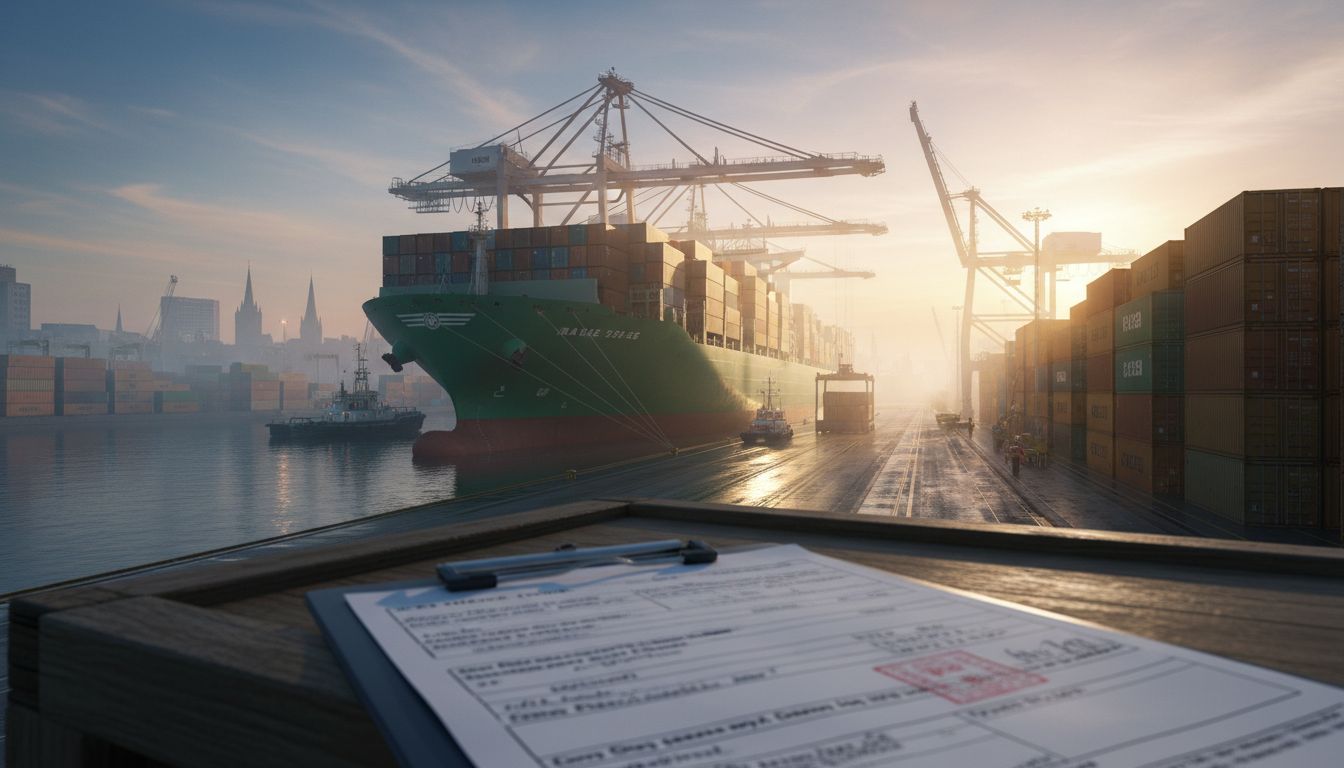
EU Import Customs Declarations: Registration & Risk Analysis

Quick answer
EU businesses importing goods into the Union must lodge an entry summary declaration electronically before arrival, using the ecustoms declaration form. This declaration is registered by customs authorities, who issue a Movement Reference Number (MRN) and perform risk analysis to ensure compliance and security [1][2].
DAsk the AI Customs Broker — free, no sign-up to try.Key takeaways
- Entry summary declarations must be lodged electronically by importers or their representatives before goods enter the EU customs territory.
- Customs authorities register each declaration or dataset submitted and issue a unique MRN to the declarant.
- Carriers can request notification of registration if they have electronic system access.
- Certain goods benefit from waivers on entry summary declarations, but risk analysis still applies at presentation.
- The Import Control System (ICS) manages the electronic processing and is subject to periodic upgrades.
- Compliance with deadlines and electronic submission requirements is mandatory for all EU market operators.
Who Must Lodge an Entry Summary Declaration?
Under the Union Customs Code and its implementing rules, any person bringing goods into the customs territory of the European Union must lodge an entry summary declaration prior to arrival [1:1]. This obligation generally applies to importers, customs representatives, or carriers depending on the circumstances and the nature of the goods.
The entry summary declaration serves as an advance notification to customs authorities, enabling risk analysis and security checks before goods physically enter the EU market. It is a prerequisite for releasing goods from customs control and for ensuring compliance with EU import regulations.
Businesses operating within the EU single market that import goods must ensure that either they or their appointed customs representatives submit the entry summary declaration electronically using the prescribed ecustoms declaration form. Failure to lodge this declaration on time can result in delays, penalties, or refusal of entry for the goods.
The Electronic System for Declarations
The entry summary declaration must be submitted electronically through the Import Control System (ICS), which is the EU-wide electronic platform for processing import notifications [1:2]. The ICS enables customs authorities to receive, register, and analyse the declarations efficiently.
The electronic system supports the submission of either a single dataset or multiple datasets for one entry summary declaration, depending on the complexity and nature of the shipment. This flexibility accommodates different supply chain scenarios, such as consolidated shipments or split consignments.
The ecustoms declaration form is the standard electronic format used to lodge these declarations. It contains all necessary data fields required by customs authorities to perform risk analysis and to track the movement of goods.
Registration and MRN Issuance
Upon receipt of an entry summary declaration, the customs authorities in the relevant Member State immediately register the submission [1:3]. This registration triggers the issuance of a unique Movement Reference Number (MRN), which serves as the official identifier for the declaration throughout the customs clearance process.
If the entry summary declaration is submitted as multiple datasets, each dataset is registered separately and assigned its own MRN [1:4]. The declarant receives immediate notification of registration and the corresponding MRNs electronically.
Carriers who have access to the electronic system and have requested notification are also informed of the registration and MRN issuance, facilitating coordination and compliance in transport operations [1:5].
The MRN is essential for tracking the customs status of the goods and for referencing in any subsequent communications or declarations related to the shipment.
Multiple Datasets for Entry Summary Declarations
In certain cases, an entry summary declaration may be composed of multiple datasets submitted separately but relating to the same consignment or shipment [1:6]. This approach is particularly relevant for complex logistics operations involving multiple transport legs or partial consignments.
Each dataset is treated as an individual submission and is registered with its own MRN. This allows customs authorities to monitor and control each part of the shipment independently while maintaining an overall view of the entire consignment.
For EU businesses, this means that when submitting the ecustoms declaration form, they must ensure that all datasets are complete and accurate to avoid discrepancies or delays during customs processing.
Notifications for Carriers
Carriers transporting goods into the EU customs territory can request to be notified electronically upon registration of the entry summary declaration [1:7]. This notification includes the MRN and the date of registration.
To receive such notifications, carriers must have access to the electronic system and must explicitly request this service. This provision enhances transparency and allows carriers to manage their logistics and compliance obligations more effectively.
Notification is particularly important when the entry summary declaration is lodged by a party other than the carrier, such as the importer or a customs representative. It ensures that carriers remain informed about the customs status of the goods they transport.
Waivers and Risk Analysis for Certain Goods
Certain categories of goods benefit from waivers that exempt them from the obligation to lodge an entry summary declaration before arrival [2:1]. These waivers are specified in Commission Delegated Regulation (EU) 2015/2446 and include goods such as postal consignments, goods in transit, and some low-risk shipments.
However, even when the entry summary declaration obligation is waived, customs authorities still perform risk analysis upon presentation of the goods at the customs office. This analysis is based on the temporary storage declaration or the customs declaration covering the goods [2:2].
EU businesses should verify whether their goods qualify for such waivers and understand that risk analysis remains a mandatory control measure to ensure security and compliance.
Key Dates and System Upgrades
The Import Control System and related electronic procedures are subject to ongoing updates and upgrades to enhance efficiency and security [1:8]. Certain provisions, such as notifications to carriers in specific cases, only apply after these upgrades are implemented.
EU importers and their representatives must stay informed about the timing of these system changes through the relevant national competent authorities. Compliance with the latest procedural requirements, including the use of the ecustoms declaration form, depends on these updates.
Adhering to key deadlines for lodging entry summary declarations and adjusting to system upgrades is critical for maintaining smooth customs clearance and avoiding operational disruptions.
FAQ
How do I get a customs declaration form?
Customs declaration forms, including the ecustoms declaration form for entry summary declarations, are accessed electronically through the Import Control System or via customs software providers authorised by the relevant Member State customs authorities [1:9].
Can I download a CN22 form?
The CN22 form is a postal customs declaration form used for small consignments and is distinct from the entry summary declaration. It is typically provided by postal services rather than customs authorities and is not part of the electronic entry summary declaration process [2:3].
Can I fill out a customs form online?
Yes, the ecustoms declaration form must be completed and submitted online through the Import Control System or authorised electronic platforms. Paper submissions are generally not accepted for entry summary declarations [1:10].
Do I need to fill out the US customs declaration form?
The US customs declaration form is required for goods entering the United States and is not applicable for imports into the European Union. EU businesses must comply with EU customs procedures and use the ecustoms declaration form for entry summary declarations [1:11].
This article provides a general overview of the EU import customs declaration requirements related to entry summary declarations and risk analysis. For specific situations or detailed guidance, EU businesses should consult qualified legal counsel or contact the relevant national competent authority.
Sources
Ready to put this into practice?
The AI Customs Broker answers procedure questions for your specific shipment, and the Document Checklist tells you exactly what paperwork it needs.