EU Tariff Quotas: Managing Import Duties and Trade Flows
Quick answer
EU tariff quotas regulate import duties by allowing a specific quantity of goods to enter the EU at a reduced or zero tariff rate. Once the quota is exhausted, higher duties apply. Understanding the difference between duty suspension vs tariff quota is essential for EU businesses to manage import costs and compliance effectively.
DLook up the duty rate — free, no sign-up to try.Key takeaways
- EU tariff quotas set a volume limit for imports at preferential duty rates; imports beyond this volume face higher tariffs [1].
- A tariff quota is considered critical when 90% of its volume is used, triggering monitoring and possible action by authorities [2].
- Tariff quotas can be allocated globally or on a country-specific basis, depending on trade patterns and safeguard measures [3].
- When a country-specific quota is exhausted, imports may access the residual global quota during the last quarter of the quota period [4].
- Tariff quota usage data is publicly available and updated regularly to ensure transparency and predictability [4:1].
- Anti-dumping and countervailing duties interact with tariff quotas, potentially affecting quota allocation and duty rates [3:1][5].
- Unused quota balances are transferred quarterly but not beyond the last quarter of the year [1:1].
What Are EU Tariff Quotas?
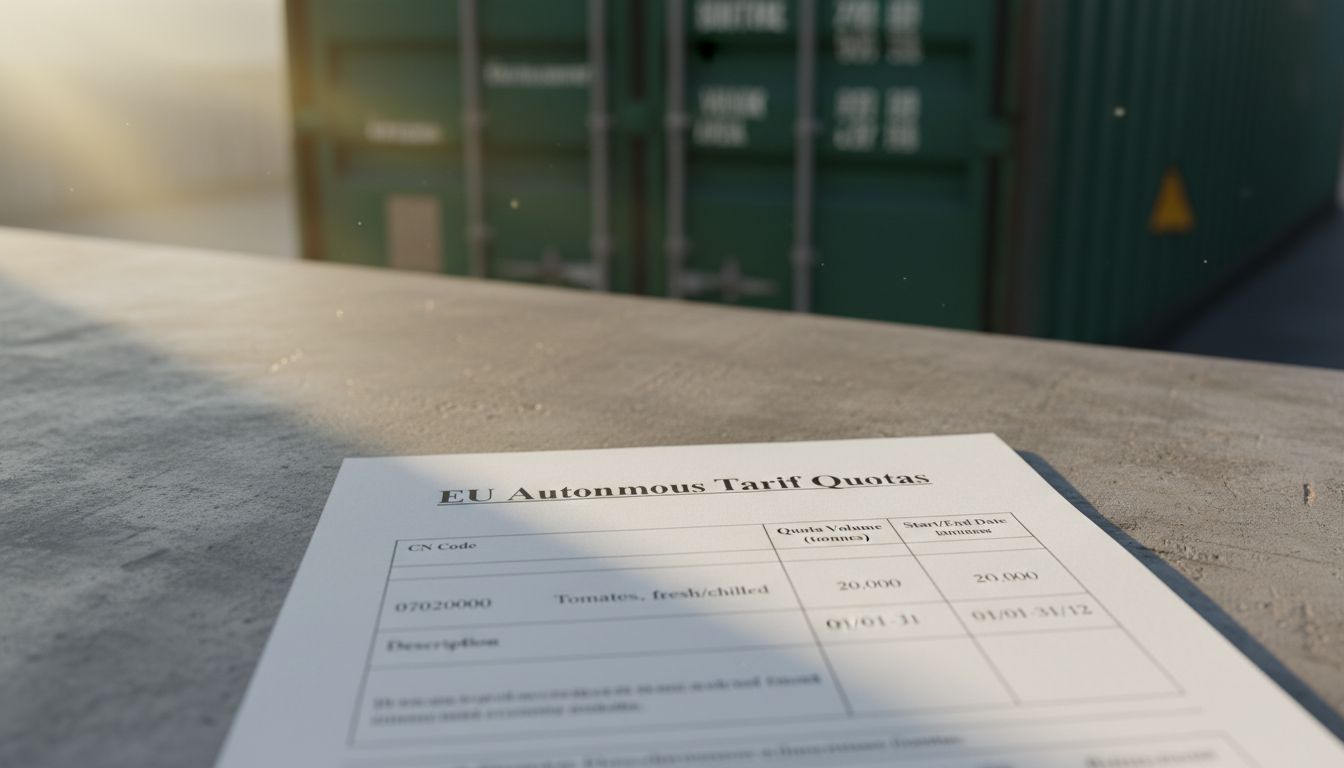
EU tariff quotas are quantitative limits on the volume of certain goods that can be imported into the EU at reduced or zero customs duties. Once the quota volume is reached, imports of the same goods are subject to higher, often punitive, tariffs. These quotas are established to protect EU industries while allowing a controlled flow of imports to meet demand and maintain trade relationships [1:2].
Tariff quotas apply to specific product categories defined by Combined Nomenclature (CN) codes and are set for defined periods. They may be part of safeguard measures or other trade policy instruments. For example, definitive safeguard measures against certain steel products impose tariff quotas with specific volumes and duty rates [1:3].
The practical effect for EU businesses is that imports within the quota volume benefit from lower duties, reducing costs and improving competitiveness. However, once the quota is exhausted, importers must pay higher duties, which can significantly increase costs and affect supply chain planning.
Understanding the distinction between duty suspension vs tariff quota is important. Duty suspension refers to temporary relief or exemption from customs duties under specific conditions, while tariff quotas set a fixed volume threshold for preferential duty application. Both mechanisms affect import costs but operate differently in practice [5:1].
How EU Tariff Quotas Are Administered
The administration of EU tariff quotas is designed to ensure equitable and efficient access for importers across the Union. Quotas are generally allocated either on a first-come-first-served basis or through country-specific allocations, depending on the product category and trade circumstances [1:4][3:2].
For many products, a portion of the tariff quota is allocated to specific countries based on their historical import volumes, while the remainder forms a global or residual quota accessible to all other countries. This mixed system balances maintaining traditional trade flows with practical administrative considerations [3:3].
Imports are admitted under the quota in chronological order based on the acceptance date of customs declarations for release into free circulation. This method ensures continuous and equal access to the quota for all importers in the EU single market [6][7].
Unused quota volumes from one quarter are automatically transferred to the next quarter within the same quota period, helping to optimize quota utilization. However, unused balances cannot be carried over beyond the last quarter of the quota period [1:5].
The relevant national customs authorities monitor quota usage and enforce the applicable duty rates. Importers must ensure their goods are correctly declared and that they hold a valid Economic Operators Registration and Identification (EORI) number for customs procedures.
Critical Status of Tariff Quotas: What It Means for Importers
A tariff quota reaches a “critical” status when 90% of its volume has been used. This threshold triggers increased monitoring and may lead to specific administrative actions to manage the quota effectively [2:1].
Certain tariff quotas are considered critical from the date of opening under specific conditions, such as when the quota period is less than three months, when equivalent quotas have not been opened in the previous two years, or when previous quotas were exhausted early or had higher volumes [2:2].
For importers, a critical tariff quota signals that the preferential duty volume is nearly exhausted, and they should prepare for the possibility of higher duties applying to subsequent imports. This status can affect purchasing and inventory strategies, as well as pricing and contract negotiations.
In some cases, tariff quotas linked to safeguard or suspension of concession measures are treated as critical as soon as 90% of the volume is used, regardless of previous quota history [2:3].
Country-Specific vs. Global Tariff Quotas
EU tariff quotas may be allocated on a country-specific basis or as global quotas available to multiple countries. Country-specific quotas are assigned to countries with significant supplying interests, typically those with more than 5% of imports in the relevant product category over the last three years [3:4].
Countries with diminished export levels due to existing anti-dumping or countervailing duties may not receive country-specific quotas and instead participate in the residual global quota. This approach prevents allocating quotas based on distorted historical import levels caused by unfair trade practices [3:5].
Global or residual quotas serve as a catch-all for countries without specific allocations, ensuring they can still access the EU market but subject to the overall quota limits. When a country-specific quota is exhausted, imports from that country may access the residual quota during the last quarter of the quota period, preserving traditional trade flows [4:2][1:6].
This mixed allocation system requires importers to be aware of their country’s quota status and the timing within the quota period to optimise duty benefits and avoid unexpected costs.
Interaction with Anti-Dumping and Anti-Subsidy Measures
Tariff quotas often interact with anti-dumping and anti-subsidy (countervailing duty) measures, which impose additional duties on imports to counter unfair trade practices. These measures can influence the allocation and use of tariff quotas [3:6][5:2].
For instance, countries subject to anti-dumping or countervailing duties may see their export volumes reduced, affecting their eligibility for country-specific quota allocations. Consequently, these countries might be grouped into the global residual quota rather than receiving dedicated quotas [3:7].
Moreover, when above-quota tariff duties exceed the level of countervailing duties, the EU may suspend the collection of countervailing duties during the period the above-quota tariff applies, effectively prioritising the higher tariff rate [5:3].
EU businesses importing products subject to both tariff quotas and anti-dumping or countervailing duties must carefully monitor the applicable duty rates and quota status to ensure compliance and cost management.
Accessing Tariff Quota Information
Transparency and predictability are key principles in the administration of EU tariff quotas. The European Commission provides publicly accessible, regularly updated data on tariff quota usage, allowing businesses to track quota consumption in real time [4:3].
Importers can consult official EU customs databases to check the current status of tariff quotas, including volumes used, remaining balances, and critical status alerts. This information is essential for planning imports and avoiding unexpected duty liabilities.
National customs authorities also provide guidance and support for importers regarding tariff quota procedures, eligibility, and compliance requirements. Businesses should ensure they have the necessary customs documentation and EORI registration to access quota benefits.
Strategic Considerations for Businesses
EU companies operating within the single market must strategically manage their imports to optimise duty costs under tariff quotas. Key considerations include:
- Monitoring quota usage and critical status to anticipate when higher duties will apply [2:4].
- Understanding the country-specific versus global quota allocations relevant to their suppliers [3:8].
- Planning import volumes and timing to maximise access to preferential duty rates, especially in the last quarter when residual quotas become accessible [4:4][1:7].
- Accounting for the interaction of tariff quotas with anti-dumping and countervailing duties, which may affect overall duty rates and quota eligibility [3:9][5:4].
- Maintaining accurate customs declarations and compliance with EU customs procedures, including holding an EORI number and cooperating with national competent authorities.
- Staying informed through official EU customs data portals and national authorities to adapt to quota changes and safeguard measures.
Understanding the distinction between duty suspension vs tariff quota is also critical. Duty suspensions provide temporary relief from duties under specific conditions, whereas tariff quotas set fixed volume limits for preferential duty application. Both affect import costs but require different compliance approaches [5:5].
By proactively managing these elements, EU businesses can mitigate risks, optimise import costs, and maintain stable supply chains within the EU single market.
FAQ
How do I check EU tariff quota usage?
Tariff quota usage data is publicly available and updated regularly by the European Commission. Importers can access this information through official EU customs databases and websites to monitor quota consumption and plan imports accordingly [4:5].
What happens when an EU tariff quota is exhausted?
Once the tariff quota volume is exhausted, imports of the relevant product are subject to a higher tariff rate, typically a 25% additional duty. For country-specific quotas, imports may access the residual global quota during the last quarter of the quota period, but outside this period, higher duties apply [1:8][4:6].
What is a ‘critical’ tariff quota in the EU?
A tariff quota is considered critical when 90% of its volume has been used. This status triggers increased monitoring and may lead to administrative actions by customs authorities. Certain quotas are deemed critical from the opening date under specific conditions such as short quota periods or lack of recent equivalent quotas [2:5].
Can unused EU tariff quota balances be carried over?
Unused quota volumes are transferred automatically from one quarter to the next within the same quota period. However, unused balances cannot be carried over beyond the last quarter of the quota period and do not accumulate year to year [1:9].
How are EU tariff quotas allocated to countries?
Country-specific tariff quotas are allocated to countries with a significant supplying interest, generally those with more than 5% of imports in the product category over the last three years. Countries affected by anti-dumping or countervailing duties with reduced exports may be included in the residual global quota instead [3:10].
This article provides general information on EU tariff quotas and related import duties. Specific situations may vary depending on the product, country of origin, and applicable trade measures. EU businesses should consult qualified legal counsel or their national competent authority for tailored advice and compliance support.
Sources
Want the duty rate for your commodity code?
The EU Tariff Lookup returns the TARIC MFN rate, preferential rates and any anti-dumping measures for your code and country of origin.