EU Autonomous Tariff Quotas: Compliance for Importers
Quick answer
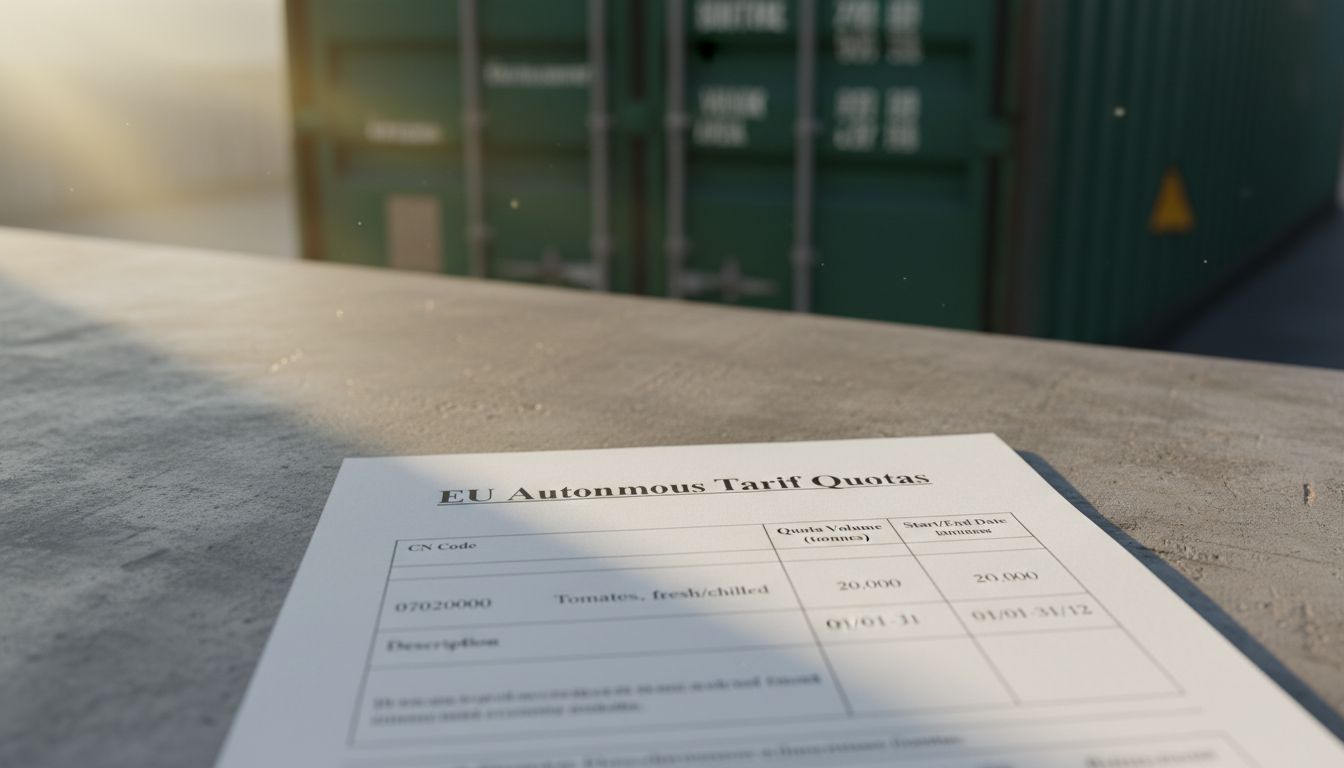
EU autonomous tariff quotas (ATQs) allow certain products to be imported into the EU at reduced or zero customs duties up to a specified quantity. Importers must comply with quota volumes, product classifications, and deadlines set by the relevant regulations to benefit from these preferential rates.
DAsk the AI Customs Broker — free, no sign-up to try.Key takeaways
- EU autonomous tariff quotas provide duty reductions or suspensions for specific agricultural and industrial products to ensure supply adequacy in the EU market [1].
- They apply to importers bringing products covered by the quotas into the EU single market.
- Quotas have defined volumes, product descriptions, and Combined Nomenclature (CN) codes that importers must observe [1:1].
- Recent amendments in 2025 updated product scopes, volumes, and tariff conditions for certain quotas [1:2].
- Importers must submit accurate customs declarations referencing the correct ATQ order numbers and comply with entry price and duty rate conditions [2][3].
- Quota utilisation is monitored and subject to deadlines; exceeding quotas may result in higher duties or denial of preferential treatment.
- Non-compliance can lead to penalties, loss of quota benefits, and customs enforcement actions.
Understanding Autonomous Tariff Quotas (ATQs)
Autonomous tariff quotas are a trade policy tool used by the European Union to regulate the importation of certain products by allowing them to enter the EU at reduced or zero customs duties within predefined quantity limits. These quotas are “autonomous” because they are established unilaterally by the EU, independently of World Trade Organization (WTO) commitments, to address specific supply needs or market conditions.
The primary objective of EU autonomous tariff quotas is to ensure an adequate supply of agricultural and industrial products that are produced insufficiently within the Union, thereby preventing market disturbances. Within the quota limits, importers benefit from reduced or suspended customs duties, facilitating competitive pricing and supply security [1:3].
The quotas are managed under Council Regulation (EU) 2021/2283 and its subsequent amendments, including Council Regulation (EU) 2025/2614, which updates the scope, volumes, and conditions of certain quotas [1:4]. The products covered by these quotas are identified by specific Combined Nomenclature (CN) codes, and each quota is assigned a unique order number for administrative and customs purposes.
Who is Affected by EU ATQs?
EU autonomous tariff quotas primarily affect businesses importing goods into the EU single market. This includes manufacturers, wholesalers, distributors, and other economic operators who rely on importing agricultural or industrial products subject to these quotas.
Importers must have a valid Economic Operators Registration and Identification (EORI) number and submit customs declarations referencing the applicable ATQ order number and CN code. Compliance with the quota conditions is essential to benefit from the reduced or zero tariff rates.
Since quotas are product- and volume-specific, importers dealing with goods covered by ATQs need to monitor quota openings, volumes, and expiry dates closely. Failure to comply with the quota conditions or exceeding the quota volume may result in the application of standard customs duties or other sanctions.
The relevant national customs authorities in the Member State where the goods enter the EU are responsible for monitoring quota utilisation and enforcing compliance [1:5].
Key Changes and Updates in 2025
Council Regulation (EU) 2025/2614 of 12 December 2025 amends the framework for autonomous tariff quotas established by Regulation (EU) 2021/2283. This amendment remains in force as of 1 July 2026 and introduces several important updates for importers:
- Certain quotas with order numbers 09.2032 and 09.2035 have been opened at zero duty rates for specified quantities of industrial products, reflecting the EU’s interest in securing adequate supply for these goods [1:6].
- The scope of quotas 09.2033 and 09.2034 has been modified to better meet the needs of economic operators, including adjustments to product descriptions and TARIC codes to ensure clarity and proper classification [1:7].
- The quota with order number 09.2728 has had its applicable Combined Nomenclature code updated due to classification changes in Annex I to Council Regulation (EEC) No 2658/87 [1:8].
- The volume of quota 09.2551 has been increased to address supply requirements, but this quota is opened only for six months to allow for production developments within the EU [1:9].
- Several quotas initially opened for six months (e.g., 09.2010, 09.2017, 09.2025, 09.2027, 09.2029, and 09.2031) have had their periods extended and volumes adapted annually to maintain market stability [1:10].
These updates require importers to review their sourcing and compliance strategies regularly to ensure adherence to the latest quota conditions and benefit from preferential tariffs.
Identifying Products Subject to ATQs
Products covered by EU autonomous tariff quotas are identified by specific CN codes listed in the relevant Commission Implementing Regulations amending Annex I to Council Regulation (EEC) No 2658/87, which governs the tariff and statistical nomenclature and the Common Customs Tariff.
For example, Commission Implementing Regulation (EU) 2023/2364 and earlier amendments specify autonomous tariff rates and entry prices for various products under these quotas. These include agricultural and industrial products with detailed duty rates such as fixed autonomous rates or rates combined with specific amounts per 100 kg/net weight [2:1][3:1][4].
The CN codes and associated tariff rates are critical for importers to correctly classify goods and calculate applicable duties. The entry price fixed on an autonomous basis and the autonomous rate of duty must be applied as per the quota conditions. Some quotas also specify additional conditions, such as entry price thresholds or specific duty increments per quantity unit [2:2][5][6].
Importers should consult the latest consolidated TARIC database and the Commission Implementing Regulations to identify the exact CN codes and tariff conditions applicable to their products to ensure correct customs declaration and quota utilisation.
Obligations for Importers Under ATQs
Importers must fulfil several concrete obligations to comply with EU autonomous tariff quotas:
-
Accurate Product Classification: Importers must classify goods under the correct CN codes as specified in the quota regulations. Misclassification can lead to denial of quota benefits or penalties [1:11].
-
Quota Order Number Reference: Customs declarations must include the correct quota order number corresponding to the product and quota volume being utilised. This ensures that imports are counted against the correct quota [1:12].
-
Compliance with Entry Price and Duty Rates: Importers must apply the autonomous rate of duty and entry price fixed on an autonomous basis for the product under the quota. These rates are detailed in the Commission Implementing Regulations and vary by product and quota [2:3][3:2].
-
Monitoring Quota Volumes: Importers are responsible for ensuring that their imports do not exceed the available quota volume. Once the quota is exhausted, standard customs duties apply [1:13].
-
Timely Customs Declarations: Importers must submit customs declarations promptly upon importation, referencing the quota and ensuring all conditions are met to benefit from the preferential tariff [1:14].
-
Record-Keeping and Documentation: Maintaining accurate records of imports under ATQs is essential for compliance verification by customs authorities.
Failure to meet these obligations can result in the loss of preferential tariff treatment and potential enforcement actions.
Managing ATQ Utilisation and Deadlines
EU autonomous tariff quotas are subject to strict volume limits and validity periods. Importers must manage their utilisation carefully to maximise benefits:
-
Quota Volumes: Each quota has a defined maximum quantity that can be imported at reduced or zero duty rates within the quota period. These volumes are updated periodically, for example, annually or semi-annually, as per Council Regulation (EU) 2025/2614 [1:15].
-
Quota Periods: Quotas may be opened for fixed periods, such as six months or one year. Importers must ensure imports occur within these periods to qualify for the preferential rates [1:16].
-
Monitoring Tools: Importers should use customs data, TARIC notifications, and communications from the relevant national competent authorities to track quota utilisation and remaining volumes.
-
Quota Exhaustion: Once a quota is fully utilised, subsequent imports of the same product are subject to the standard Common Customs Tariff rates, which are generally higher [2:4][3:3].
-
Extensions and Amendments: Some quotas may be extended or amended, as seen in the 2025 regulation updates. Importers should stay informed of such changes to adjust their import strategies accordingly [1:17].
Effective management of quota utilisation helps avoid unexpected customs duty costs and ensures continuous supply under preferential conditions.
Consequences of Non-Compliance
Non-compliance with EU autonomous tariff quota conditions can have significant consequences for importers:
-
Loss of Preferential Tariff Treatment: If imports exceed the quota volume or do not meet classification and declaration requirements, the reduced or zero duty rates no longer apply, and standard duties become payable [1:18].
-
Customs Penalties and Fines: National customs authorities may impose penalties for incorrect declarations, misclassification, or failure to comply with quota rules.
-
Delays and Additional Controls: Non-compliant shipments may be subject to additional customs inspections, delays, and administrative burdens.
-
Reputational Risk: Persistent non-compliance can damage business relationships and credibility with customs authorities and trading partners.
To mitigate these risks, importers should implement robust compliance procedures, maintain up-to-date knowledge of quota regulations, and engage with the relevant national competent authorities for guidance.
FAQ
What is an autonomous tariff quota?
An autonomous tariff quota is a quantity limit set unilaterally by the EU allowing certain products to be imported at reduced or zero customs duties within that limit. It aims to secure supply and stabilise markets for products insufficiently produced in the EU [1:19].
What is the EU scheme for autonomous tariff suspensions and quotas?
The EU scheme, governed by Council Regulation (EU) 2021/2283 and amended by Regulation (EU) 2025/2614, opens and manages quotas for specific agricultural and industrial products. It sets product scopes, volumes, duty rates, and conditions under which importers can benefit from tariff suspensions or reductions [1:20].
What is the tariff rate quota in the EU?
A tariff rate quota is a mechanism where a lower tariff rate applies to imports of a product up to a specified quantity. Imports beyond that quantity are subject to higher standard tariffs. EU autonomous tariff quotas are a form of tariff rate quotas managed autonomously by the EU [1:21].
Does the EU want zero tariffs?
While the EU aims to facilitate trade and supply through tariff suspensions and reductions, including zero tariffs under certain autonomous quotas, it maintains tariffs on many products to protect internal markets and industries. Zero tariffs apply selectively within quota limits and product categories [1:22].
Sources
Still need the answer for your own shipment?
Ask the AI Customs Broker. It classifies, values and clears your goods against the live EU rules, and cites the regulation behind every answer.