EU Customs Quota Security Deposits: Importer Obligations
Quick answer
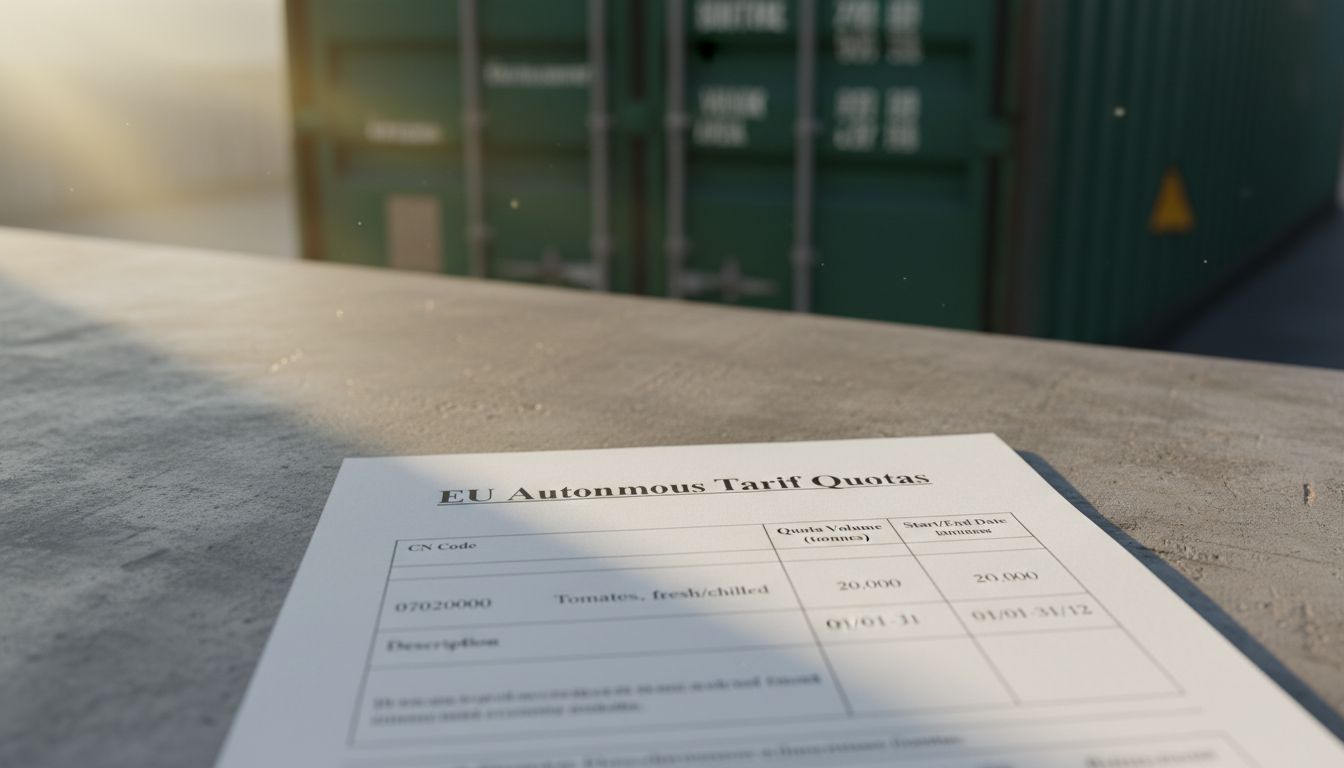
EU businesses importing goods under tariff quotas may be required to lodge an EU customs quota security deposit either when applying for quota authorisation or at customs declaration. The obligation applies mainly to tariff quotas managed on a first-come, first-served basis, including certain fruit and vegetable imports, with specific rules on timing, calculation, and release of the security [1][2].
DAsk the AI Customs Broker — free, no sign-up to try.Key takeaways
- Security deposits are generally required when applying for tariff quota authorisation or lodging customs declarations for quota goods.
- The obligation applies to tariff quotas managed by chronological order of application submission.
- Special rules apply for fruit and vegetable imports, including proof of correct pricing within deadlines to release the security.
- Autonomous rates of duty influence the calculation of security deposits for some tariff quotas.
- Requests for tariff quotas with entry in declarant’s records must be made via supplementary declarations.
- Failure to meet conditions for security deposit release can lead to forfeiture and duty payment.
- The exchange rate for security deposits follows the rules set out in Regulation (EU) No 1306/2013.
Who Must Lodge a Security Deposit for EU Tariff Quotas?
Operators seeking to benefit from reduced import duties under EU tariff quotas managed on a chronological basis must lodge a security deposit with the competent national customs authority. This obligation arises either when submitting an application for an authorisation for end-use or when lodging the customs declaration for release for free circulation, depending on the procedure used [1:1].
The security deposit serves as a financial guarantee to ensure compliance with quota conditions and payment of duties if the quota is exceeded or conditions are not met. It applies primarily to tariff quotas that are allocated based on the chronological order of applications, which is common for WTO tariff quotas and other quota arrangements listed in the Common Customs Tariff [3][4].
EU importers operating within the single market must verify whether the goods they import fall under such tariff quotas and whether a security deposit is required. This includes checking the relevant commodity codes and quota management rules published by the European Commission and national customs authorities.
When to Lodge a Security Deposit for Tariff Quotas
The timing of lodging the EU customs quota security deposit depends on the customs procedure chosen:
- At the time of application for quota authorisation: When applying for an authorisation for end-use under Article 211 of the Union Customs Code (UCC), the security must be lodged simultaneously with the application.
- At the time of customs declaration: When the customs declaration for release for free circulation is lodged, if no prior authorisation application was made.
This dual timing option allows flexibility depending on the importer’s operational preferences but does not exempt the operator from the security deposit obligation if they wish to benefit from the reduced tariff quota rate [1:2].
The exchange rate used to calculate the security deposit amount is established according to Article 106 of Regulation (EU) No 1306/2013, ensuring consistency with the agricultural policy framework [1:3].
Security Deposits for Fruit and Vegetable Imports
Fruit and vegetable imports under tariff quotas are subject to specific security deposit rules due to the sensitivity of these products and their pricing mechanisms.
Importers must classify products according to the entry price, which can be chosen as:
- The FOB price in the country of origin plus insurance and freight costs up to the EU border, provided these prices are known at the time of customs declaration.
- The customs value calculated under the UCC.
- The standard import value as defined in the relevant EU rules.
If the FOB price plus costs exceeds the standard import value by more than 8%, the importer must lodge a security equal to the duty that would be payable based on the standard import value. Similarly, if the customs value method is chosen, a corresponding security deposit must be lodged [2:1].
Importers have one month from the sale of the products, and no later than four months from the acceptance of the customs declaration, to prove that the prices declared are correct. Failure to provide satisfactory proof within these deadlines results in forfeiture of the lodged security, which is then used to cover import duties. Customs authorities may grant an extension of up to three months upon a duly substantiated request [2:2].
This procedure ensures that importers do not under-declare values to benefit from lower duties, protecting the integrity of tariff quotas for fruit and vegetables.
Impact of Autonomous Rates of Duty on Security Deposits
Certain tariff quotas are subject to autonomous rates of duty, which are fixed or variable amounts set by the EU independent of WTO commitments. These rates influence the calculation of security deposits.
For example, Commission Implementing Regulations (EU) 2022/1998 and 2023/2364 list autonomous rates of duty for various commodity codes within tariff quotas. These rates may include a fixed base amount plus additional charges per 100 kg net weight, varying by product [3:1][4:1][5][6][7].
Importers must apply the correct autonomous rate of duty to calculate the amount of security deposit required. This ensures that the security covers the maximum potential duty payable if the quota is exceeded or conditions are not met.
The presence of autonomous rates means that security deposits can vary significantly between tariff quotas and products. Therefore, EU businesses must consult the latest Common Customs Tariff annexes and implementing regulations to determine the applicable rates for their imports.
Requesting Tariff Quotas with Entry in Declarant’s Records
When customs declarations are lodged in the form of an entry in the declarant’s records for release for free circulation, the procedure for requesting tariff quotas differs slightly.
The holder of the authorisation to lodge such declarations must request the granting of the tariff quota in a supplementary declaration. This request can only be processed after the supplementary declaration is lodged, but the date the goods were entered in the declarant’s records is used to allocate the tariff quota chronologically [8].
Until national import declaration systems are upgraded, some Member States may allow the request for tariff quota benefit to be made in a form other than a supplementary declaration, provided all necessary information is available to assess the request [8:1].
This procedure is important for importers using self-assessment or simplified customs procedures, ensuring they can still benefit from tariff quotas while complying with the EU customs formalities.
Consequences of Failing to Meet Security Deposit Conditions
Failure to lodge the required EU customs quota security deposit or to meet conditions for its release can have significant consequences for importers.
If an importer does not provide the security deposit when required, they risk losing eligibility for the reduced tariff quota rate and may be subject to the full autonomous or most-favoured-nation duty rates.
In the case of fruit and vegetable imports, failure to prove correct pricing within the prescribed deadlines leads to forfeiture of the security deposit. The forfeited amount is applied to cover the import duties, which may be higher than initially declared if the standard import value is used as a reference [2:3].
Non-compliance can also lead to delays in customs clearance, administrative penalties, or increased scrutiny from customs authorities.
EU businesses must ensure timely lodgement of security deposits, accurate customs declarations, and compliance with all documentary and procedural requirements to avoid these risks.
Next steps
- Identify whether the goods you import fall under tariff quotas managed by chronological order and require an EU customs quota security deposit.
- Calculate the security deposit amount using the applicable autonomous rate of duty or standard import value, applying the correct exchange rate per Regulation (EU) No 1306/2013.
- Lodge the security deposit either when applying for quota authorisation or at customs declaration, as appropriate.
- For fruit and vegetable imports, maintain documentation to prove correct pricing and submit it within one month of sale or four months of customs declaration acceptance.
- If using entry in declarant’s records, submit a supplementary declaration requesting the tariff quota benefit promptly.
FAQ
What is an EU customs quota security deposit?
It is a financial guarantee lodged by importers to secure the payment of duties and compliance with conditions when importing goods under tariff quotas managed on a chronological basis in the EU [1:4].
How do I apply for an EU tariff quota with a security deposit?
You lodge the security deposit either when submitting an application for authorisation for end-use or when lodging the customs declaration for release for free circulation, depending on your procedure [1:5].
When is a security deposit required for importing fruit and vegetables into the EU?
When the entry price declared exceeds the standard import value by more than 8%, or when using customs valuation methods, a security deposit equal to the potential additional duty must be lodged [2:4].
What happens if I don’t meet the conditions for releasing my customs security deposit?
Failure to prove correct pricing or meet deadlines results in forfeiture of the security deposit, which is applied to cover import duties [2:5].
Are all EU tariff quotas subject to a security deposit?
No, security deposit obligations apply mainly to tariff quotas managed on a chronological basis; other quotas may have different arrangements [1:6].
How is the exchange rate determined for EU customs security deposits?
The exchange rate is established in accordance with Article 106 of Regulation (EU) No 1306/2013, ensuring consistency with EU agricultural policy rules [1:7].
Sources
Still need the answer for your own shipment?
Ask the AI Customs Broker. It classifies, values and clears your goods against the live EU rules, and cites the regulation behind every answer.