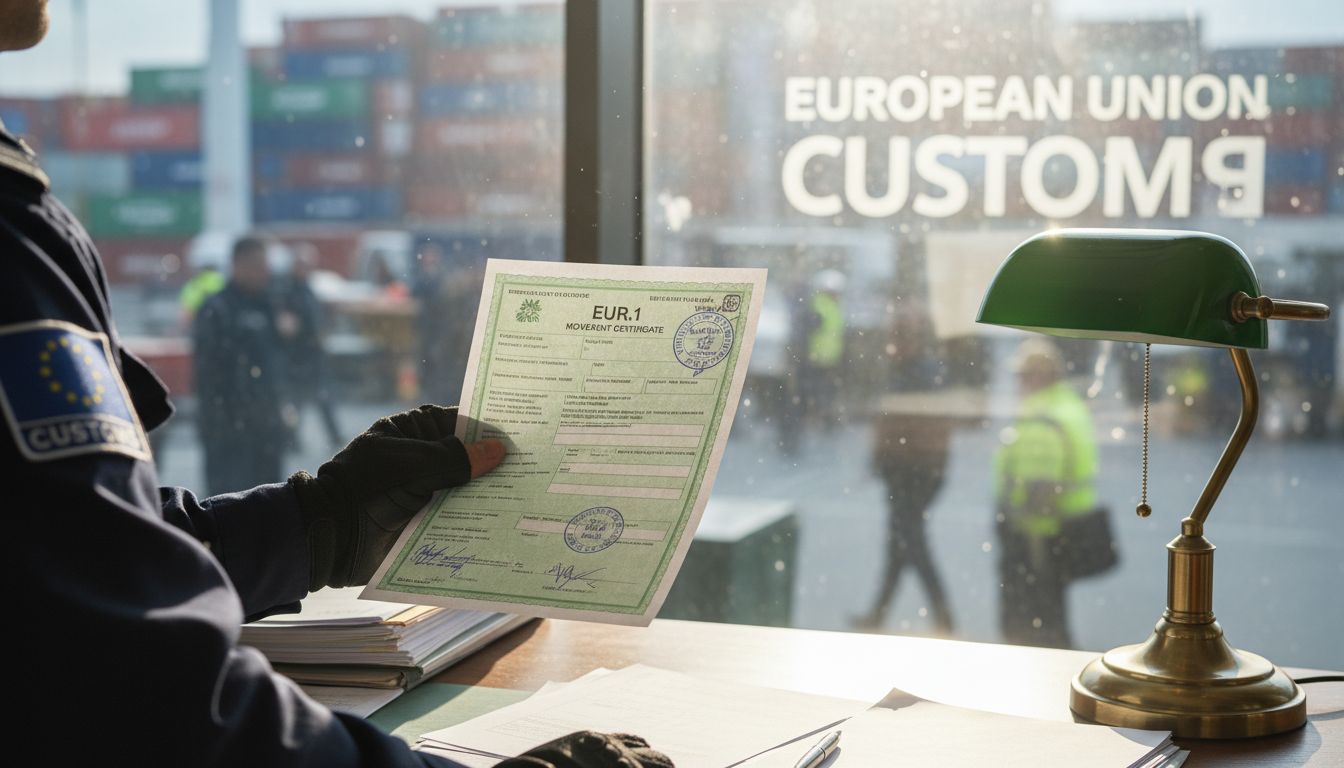
EU Import: Certificate of Origin Form A Requirements

Quick answer
A Certificate of Origin Form A is required for certain preferential trade arrangements to prove the origin of goods imported into the EU. It must follow a strict country of origin certificate format, be issued by competent authorities, and comply with detailed completion and presentation rules to ensure customs compliance.
DCheck preferential origin — free, no sign-up to try.Key takeaways
- Form A certificates are mandatory for preferential tariff treatment under specific EU trade agreements [1].
- The certificate must follow a defined country of origin certificate format, including specific boxes and handwritten signatures [1:1][2].
- Certificates can be issued retrospectively or as duplicates under strict conditions [1:2].
- Special provisions apply for cumulation of origin and certain steel products [3][4][5].
- Technical specifications cover paper quality, dimensions, and security features to prevent fraud [6].
- Certificates are valid for 12 months from the date of issue and only originals are accepted by EU customs [6:1].
- The certificate must be presented to the relevant Member State customs authorities upon import [1:3].
When is a Certificate of Origin Form A Required?
A Certificate of Origin Form A is required primarily to benefit from preferential tariff treatment under the EU’s Generalised Scheme of Preferences (GSP) and other trade arrangements. Exporters or their authorised representatives must apply for this certificate to prove that the goods qualify as originating in the beneficiary country [1:4].
The certificate must be issued before exportation, except in exceptional cases such as errors, omissions, or special circumstances where retrospective issuance is permitted [1:5][7]. This ensures that EU customs authorities can verify the preferential origin status of imported goods, facilitating correct customs duty application.
The certificate is especially relevant for importers operating within the EU single market who rely on preferential rates under trade agreements. Without a valid Form A certificate, preferential treatment may be denied, leading to higher customs duties and potential delays.
Key Elements of the Certificate of Origin Form A
The Certificate of Origin Form A follows a strict country of origin certificate format, as set out in Annex 17 of Commission Regulation (EU) No 1063/2010 [1:6]. Key elements include:
- Exporter details (name, full address, country)
- Consignee details (name, full address, country)
- Description of goods with Harmonised System (HS) or Combined Nomenclature (CN) codes
- Country of origin of the goods
- Place and date of shipment, means of transport
- Signatures of the competent governmental authority and exporter’s authorised signatory
Boxes 2 and 10 on the form are optional, while Box 12 must bear the mention “European Union,” “Union,” or the name of a Member State [1:7][2:1]. The date of issue is indicated in Box 11. Both the issuing authority’s and the exporter’s signatures must be handwritten to ensure authenticity [1:8][2:2].
The certificate must be completed in one of the official EU languages and must not contain erased or overwritten entries. Any corrections must be crossed out, initialled, and endorsed by the issuing authority [6:2].
Completing Specific Boxes on Form A
Accurate completion of the Form A certificate is critical for acceptance by EU customs. The following boxes require particular attention:
- Box 1 (Exporter): Full legal name, address, and country of the exporter.
- Box 5 (Consignee): Full name, address, and country of the importer or final recipient.
- Box 6 (Country of Origin): The country where the goods originate, which determines eligibility for preferential treatment.
- Box 7 (Country of Destination): The country where the goods are shipped, typically the EU Member State of import.
- Box 8 (Place and Date of Shipment): Details of shipment and transport mode.
- Box 11 (Date of Issue): Date when the certificate is issued by the competent authority.
- Box 12 (Signatures and Mentions): Handwritten signatures of the issuing authority and exporter; must include “European Union,” “Union,” or a Member State name [1:9][2:3].
If the certificate is issued retrospectively or as a duplicate, Box 4 must contain the appropriate endorsement, such as “Issued retrospectively” or “Duplicate” [1:10][6:3].
Issuance Procedures: Original, Retrospective, and Duplicates
The competent governmental authorities of the exporting country issue the Certificate of Origin Form A upon written application by the exporter or their authorised representative, supported by documents proving the goods’ origin [1:11].
Original Certificates
Original certificates must be issued before or at the time of export. They are valid for 12 months from the date of issue and must be presented in original form to EU customs [6:4].
Retrospective Issuance
Certificates may exceptionally be issued after exportation if:
- The certificate was not issued due to errors, involuntary omissions, or special circumstances.
- The certificate was issued but not accepted at importation for technical reasons.
Retrospective certificates require verification by the competent authorities that the information matches the export file. Box 4 must be endorsed with “Issued retrospectively” in the appropriate language [1:12][6:5].
Duplicates
In case of theft, loss, or destruction, exporters may request duplicates based on export documents held by the issuing authorities. Duplicates must be clearly marked “Duplicate” in Box 4, including the original certificate’s serial number and date. The duplicate is effective from the original certificate’s date [1:13].
Special Cases: Cumulation and Steel Products
Cumulation
Cumulation allows materials originating in certain countries to be considered as originating in the beneficiary country for the purposes of preferential treatment. The competent authorities issuing Form A certificates rely on proof of origin from suppliers according to the type of cumulation applied:
- Bilateral cumulation: proof from exporter’s supplier per Article 77 of Commission Implementing Regulation (EU) 2015/2447.
- Cumulation with Norway, Switzerland, or Turkey: proof per respective GSP rules.
- Regional and extended cumulation: proof per relevant free-trade agreements.
Box 4 of the certificate must indicate the type of cumulation applied, e.g., “EU cumulation” or “regional cumulation” [3:1][8].
Steel Products
For certain steel products originating in countries such as Ukraine or Kazakhstan, a specific certificate of origin format applies, as detailed in Council Regulations (EC) No 1755/2006 and No 1531/2007. These certificates include additional fields such as product group, CN code, net weight, and FOB value, and must be signed and stamped by the competent authority [4:1][5:1].
Technical Specifications for Certificates of Origin
The EU mandates precise technical standards for certificates of origin to ensure authenticity and uniformity:
- Dimensions: 210 × 297 mm, with a tolerance of +8 mm or -5 mm in length [6:6].
- Paper: White, minimum weight 40 g/m², without mechanical pulp.
- Security: Original certificates must have a yellow guilloche patterned background to prevent forgery.
- Format: Single sheet marked “original”; copies marked “copy” [6:7].
- Language: Printed and completed in typescript in an official EU language.
- Corrections: No erasures or overwriting allowed; corrections must be crossed out, initialled, and endorsed by issuing authorities [6:8].
- Serial Number: Each certificate must bear a unique serial number and be stamped and signed by the issuing authority [6:9].
These technical requirements form part of the country of origin certificate format that EU importers must verify to ensure compliance and acceptance by customs.
Validity and Presentation to EU Customs
The validity of a Certificate of Origin Form A is 12 months from the date of issue by the competent authority [6:10]. Only the original certificate is accepted by EU customs; copies are not valid for preferential treatment purposes.
Importers must present the original certificate to the customs authorities of the Member State where the goods are declared for release for free circulation. The certificate serves as proof that the goods meet the origin criteria under the relevant preferential trade agreement.
Failure to present a valid certificate in the correct country of origin certificate format may result in denial of preferential treatment, leading to payment of full customs duties and potential delays in customs clearance.
FAQ
What is the format of a Certificate of Origin?
The format of a Certificate of Origin Form A is strictly defined by EU regulations, including a standard layout with numbered boxes for exporter, consignee, description of goods, country of origin, and signatures. It must be printed on specified paper size with security features and completed in an official EU language [1:14][6:11].
How do I get a country of origin certificate?
An exporter or their authorised representative must apply in writing to the competent governmental authorities of the exporting country, providing supporting documents proving the goods’ origin. The authorities then issue the certificate if the conditions are met [1:15].
Can I make my own Certificate of Origin?
No, a Certificate of Origin Form A must be issued by the competent governmental authorities or a reliable agency authorised by them. Self-issued certificates by exporters without official endorsement are not accepted for preferential treatment [1:16][7:1].
What should I put for country of origin?
The country of origin is the country where the goods are considered to originate under the relevant rules of origin. This must be accurately stated in Box 6 of the certificate, as it determines eligibility for preferential tariffs [1:17].
What is a Form A certificate of origin?
Form A is the official model certificate used under the EU’s Generalised Scheme of Preferences and other trade agreements to certify that goods originate in a beneficiary country, enabling preferential customs treatment [1:18].
Who issues a certificate of origin for imports?
Competent governmental authorities or authorised agencies in the exporting country issue the certificate. These authorities verify the origin of the goods before issuing the certificate [1:19][7:2].
Next steps
- Confirm whether your goods qualify for preferential treatment requiring a Certificate of Origin Form A by reviewing the relevant EU trade agreement rules.
- Prepare and gather all supporting documents proving the origin of your products for submission to the competent governmental authority.
- Submit a written application for the Form A certificate to the competent authority before exportation, ensuring the correct country of origin certificate format is used.
- Verify the completed certificate for accuracy, including all mandatory boxes, handwritten signatures, and security features.
- Present the original certificate to the customs authorities of the EU Member State where your goods are imported to claim preferential tariff treatment.
Sources
Could your goods qualify for a preferential rate?
The FTA & Origin Checker tells you whether an agreement covers your goods, which origin rule applies, and what proof you need to claim it.