EUR.1 Rejected: The €22,340 Bill for an Origin Rule Nobody Read
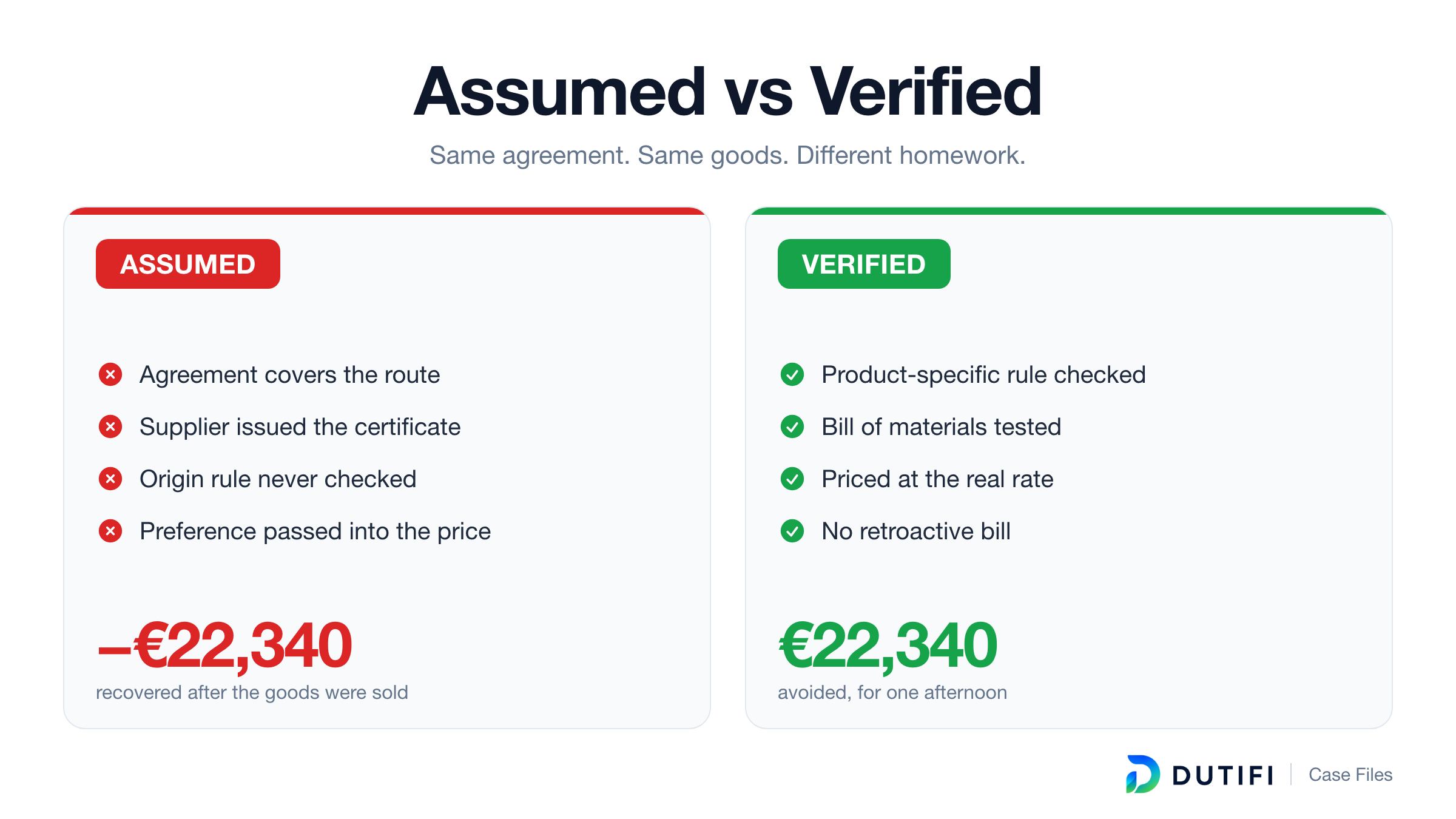
An importer lost €22,340 by claiming preferential duty on an agreement that did cover their route, without checking whether their product actually met the origin rule inside it.
Picture a mid-sized EU distributor buying electrical assemblies from a supplier in a partner country with a free trade agreement in force. Consignment value is around €260,000. The supplier issues a movement certificate, the distributor claims preference, the goods clear at the preferential rate, and the saving is passed straight into the sales price to win the account.
The bit that looks like it is settled but is not
There are two questions in every preference claim, and people routinely answer only the first.
The first question is whether an agreement covers the trade. That one is easy, and the answer here was yes. The second is whether this specific product satisfies the product-specific rule of origin in that agreement, which is a different test entirely. Rules of origin are set per product. Some require a change of tariff heading, some cap the value of non-originating materials, some demand a named process. Two goods shipped in the same container under the same agreement can land on opposite sides of the line.
The assemblies here were built in the partner country, which felt like enough. But most of the value sat in components bought in from a third country, and the operation performed locally did not go far enough to confer origin under the applicable rule. The certificate had been issued in good faith. It was still wrong.
Preference claims are verifiable after clearance, and that is the part that bites. A customs authority can ask the partner country to confirm the origin of a consignment released months earlier, and if the answer does not come back clean, the duty becomes payable as though preference had never been claimed. The framework for that verification sits in the Union Customs Code implementing rules and, for the pan-Euro-Mediterranean zone, in the regional convention on preferential rules of origin.
By the time the verification result arrived, the goods had been sold. At the preferential price.
| Line item | Cost |
|---|---|
| Duty recovered retroactively on the consignment | €15,600 |
| Interest on the recovered amount | €1,140 |
| Administrative penalty | €2,400 |
| Origin audit, advisor time and re-declaration | €3,200 |
| Total | €22,340 |
Figures are representative composites based on typical published charges and penalty ranges, not data from a specific client. Actual costs vary by jurisdiction, carrier and case. Full disclaimer.
The penalty and interest lines vary the most. Interest runs from the date the duty should have been paid, so a verification that lands eighteen months later costs more than one that lands in three months. Penalties are national. Some authorities treat a good-faith claim backed by a supplier certificate far more leniently than a repeat error, and a distributor who can show they checked the rule tends to be treated better than one who cannot.
What the alternative cost
Checking the product-specific rule before the first claim. That is it.
The rule for the heading was published, the bill of materials was already on file, and the question of whether the local operation cleared the threshold was answerable in an afternoon. Had the answer come back negative, the distributor had two ordinary options: price the goods at the third-country rate and keep the margin honest, or work with the supplier on sourcing so the product would genuinely qualify. Both are cheaper than selling on a saving you turn out not to have.
The lesson
A trade agreement covering your route is not a duty saving. It is permission to test whether your product qualifies for one, and the test is per product, against a specific rule, on your actual bill of materials.
Treat a supplier’s certificate as a claim to be checked rather than a conclusion to be relied on. The supplier is not the one who pays when it fails. And be careful about passing a preference into your sales price before you have confirmed the rule, because that is what turns a duty correction into a margin loss you cannot recover from anyone.
The FTA and Origin Lookup shows the product-specific rule for your commodity code under each agreement that covers it, and the proof of origin each one requires.
Has anyone had a preference claim come back on them after the goods were already sold? How far after clearance did it surface?