The €67,470 Duty Nobody Budgeted For: An Anti-Dumping Measure Missed at Quotation
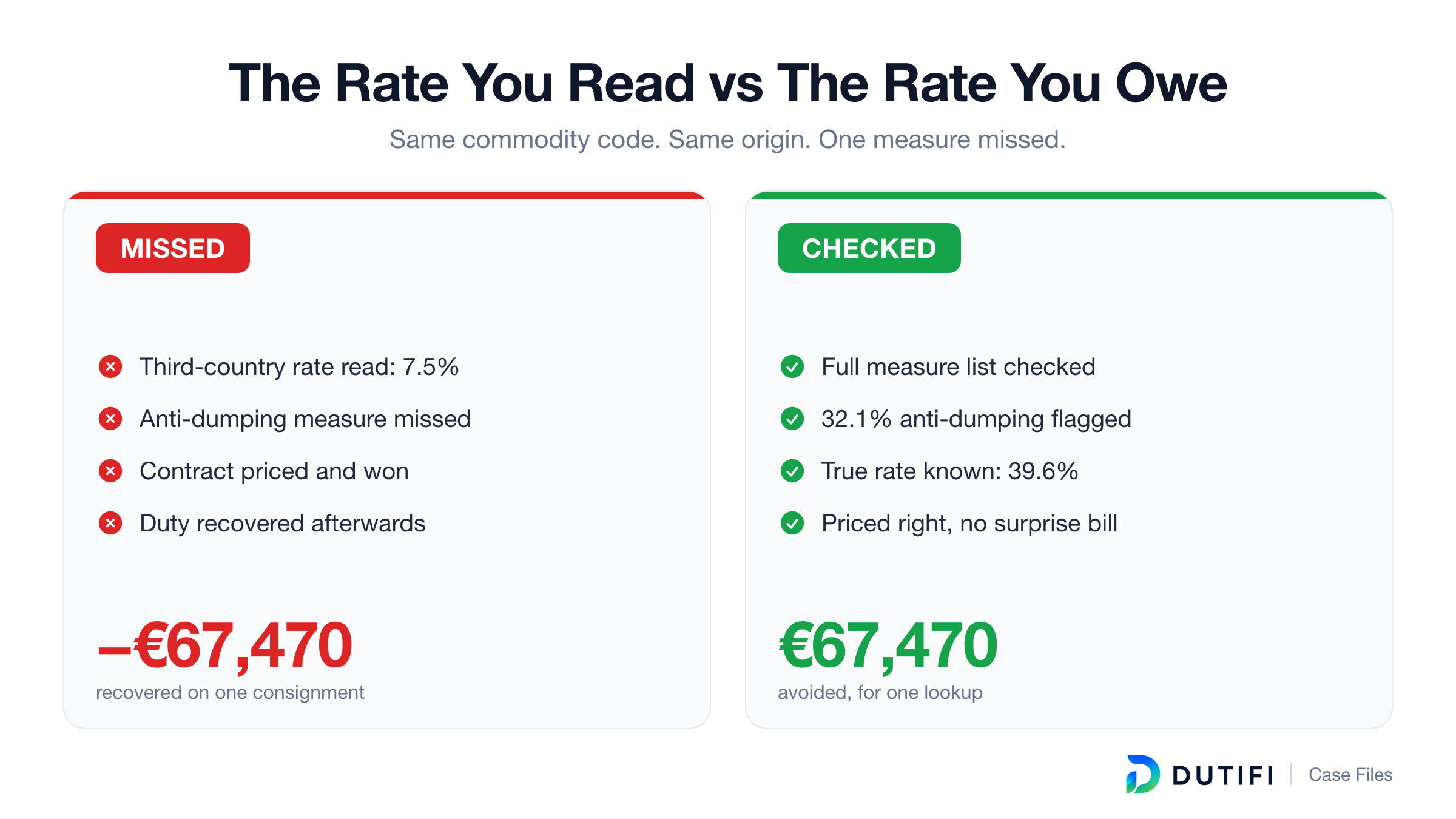
An importer quoted a job on 7.5% duty, shipped it, and then found the commodity code also carried a 32.1% anti-dumping measure, which turned a priced contract into a €67,470 problem.
Picture an EU fabricator buying aluminium extrusions from a Chinese supplier for a construction contract. Customs value on the consignment is €180,000. Somebody looks up the commodity code, reads the third-country duty, sees 7.5%, and builds the quote on it. The quote wins the job.
Two duties live on the same code
The third-country rate is the headline number on a commodity code, and for CN 7604 21 00 it really is 7.5%. That figure is correct. It is also incomplete.
Sitting on the same code, applying only to goods originating in China, is a definitive anti-dumping duty of 32.1%. It has been in force since 31 March 2021 under Commission Implementing Regulation (EU) 2021/546. It is not an alternative to the third-country rate. It stacks on top of it.
So the fabricator budgeted 7.5% and owed 39.6%.
There is a wrinkle that makes this worse rather than better. That 32.1% is the residual rate, the one that applies to “all other companies”. Several named Chinese exporters have their own lower rates, in the low-to-mid twenties, but those only apply where the goods are accompanied by a valid commercial invoice meeting the conditions in the regulation, tied to the exporter’s additional code. Buyers often hear “our rate is 22%” from a supplier and take it as settled. If the paperwork does not carry the right additional code and certificate, the residual rate is what customs will apply, whatever the supplier said.
None of this is hidden. It sits in the tariff against the code, alongside the measure everybody does read. It is simply on a line most people never scroll to, and it is invisible if you look the code up somewhere that only reports the standard rate.
| Line item | Cost |
|---|---|
| Anti-dumping duty at 32.1% on a customs value of €180,000 | €57,780 |
| Interest on the recovered amount | €2,890 |
| Administrative penalty | €4,200 |
| Customs advisor, re-declaration and audit support | €2,600 |
| Total | €67,470 |
Figures are representative composites based on typical published charges and penalty ranges, not data from a specific client. Actual costs vary by jurisdiction, carrier and case. Full disclaimer.
The duty line is the exception to that note, and it is worth being precise about which parts are which. The 7.5% and 32.1% rates and the March 2021 start date are real, taken from the EU tariff for this code and origin as it stands in July 2026. The interest, penalty and advisor lines are the composite ones, because those are national and vary by how the case is handled.
One more thing on that duty line, and it is the reason this article carries a review date. An expiry review of this measure opened in March 2026. A measure under review stays in force while the review runs, so nothing about the rate above changes today, but the position after the review may differ. That is exactly the kind of detail that makes a duty figure a perishable thing rather than a fact you can memorise.
What the alternative cost
Reading the full measure list for the code and the origin, before quoting. Not the standard rate. The whole list.
That is a lookup, and it is the same lookup either way. Had it surfaced the anti-dumping measure, the fabricator had ordinary choices: quote the job at the real landed cost, source the extrusions from an origin without the measure, or go to a named exporter and make the certificate a contractual condition rather than a verbal assurance. All three are ordinary commercial decisions. None of them is available once the contract is signed at the wrong price.
The lesson
A commodity code does not have a duty rate. It has a set of measures, and the third-country rate is only the first of them. Anti-dumping and countervailing duties are origin-specific, which means the same code can be cheap from one country and punitive from another, and the difference can be several times the rate you were expecting.
Check the measures for the code and the origin together, never the code alone. Treat a supplier’s quoted duty rate as a claim that needs the paperwork to back it. And re-check before you rely on an old answer, because measures start, expire and get reviewed on their own timetable rather than yours.
The TARIC Tariff Lookup returns the third-country rate, preferential rates and any anti-dumping or countervailing measures for a code and origin together, on one screen.
Has an anti-dumping measure ever landed on a job you had already priced? How did you handle the contract?