One Missing Invoice Detail, 11 Days of Demurrage, €4,100 Off a €6,000 Margin
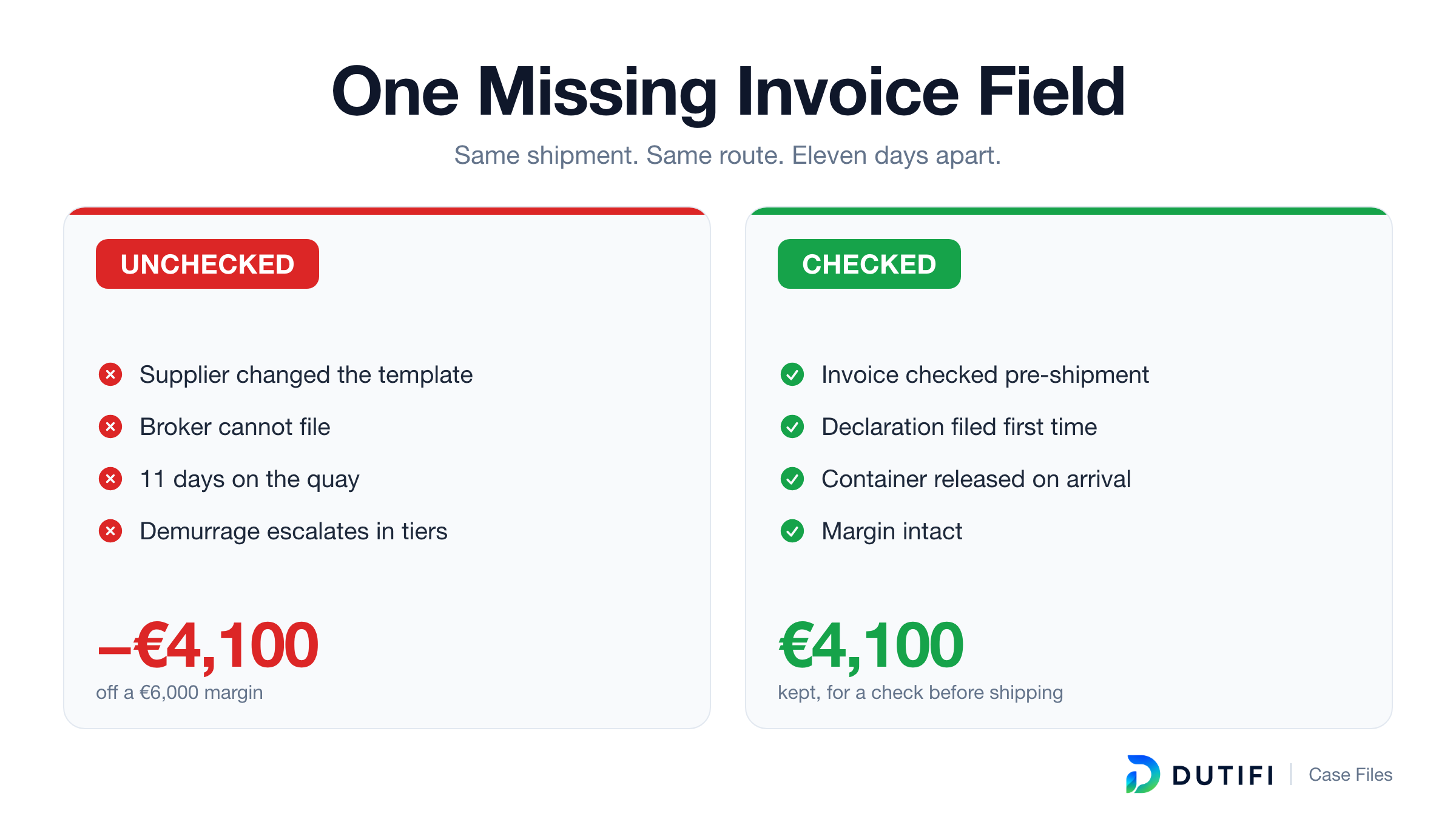
A shipment sat 11 days at the port of entry because the commercial invoice was missing one detail the customs declaration needed, and the delay cost €4,100 out of a €6,000 margin.
Picture a small EU importer bringing in a container of finished goods on a route they run every month. Invoice value is modest, the margin on the container is about €6,000, and the paperwork is handled by whoever is free that week. The supplier changes the layout of their invoice template. Nobody notices.
Why one field stops a container
A customs declaration is not a summary. It is a set of specific particulars, and the supporting documents have to carry the facts behind them. The delegated and implementing rules under the Union Customs Code set out what a declaration must contain and what has to be available to support it. You can read them at Regulation 2015/2446 and Regulation 2015/2447.
When one of those facts is not on the invoice, the broker cannot simply infer it. They can guess, which risks an incorrect declaration and a much larger problem later, or they can go back to the importer and ask. So they ask. The importer asks the supplier. The supplier is in a different time zone, the person who owns the template is on leave, and the answer takes four working days to arrive in a form the broker can actually file against.
Meanwhile the container is on the ground and the clock is running. That is the whole mechanism. No penalty, no investigation, no dispute with customs. Just a question nobody could answer quickly, and a per-day charge that does not care why.
The importer had no process for this. The invoice was read as a price document, not as the evidence base for a legal declaration, so nothing checked it for completeness before the goods shipped. The gap surfaced at the worst possible moment, which is after arrival, when every hour has a price.
| Line item | Cost |
|---|---|
| Demurrage, 11 days at the port of entry | €2,860 |
| Container storage and quay rent | €640 |
| Broker re-submission and amendment fee | €350 |
| Out-of-hours document retrieval and courier | €250 |
| Total | €4,100 |
Figures are representative composites based on typical published charges and penalty ranges, not data from a specific client. Actual costs vary by jurisdiction, carrier and case. Full disclaimer.
Demurrage is the line to check against your own numbers, because it is set by the carrier and it escalates. Free time is typically a handful of days, then the daily rate steps up in tiers the longer the container sits. The same 11 days at a different port, under a different carrier’s tariff, could be half this or comfortably double it.
Worth separating two charges that get used interchangeably and are not the same thing. Demurrage is what the carrier charges while their container sits inside the terminal beyond its free time. Detention is what they charge once you have taken the container out and not returned it. A clearance delay generates demurrage, because the box never leaves. A yard or unloading problem generates detention. They run on different clocks at different rates, and an invoice that lumps them together is worth querying, because the two have different causes and different people inside your business are able to fix them.
What the alternative cost
Reading the invoice before the goods left, against a list of what the declaration would need.
That is a few minutes per shipment. On this route the importer had run the same paperwork monthly without incident, which is exactly why the template change went unnoticed. A check that runs every time catches the month the supplier quietly redesigns their document. A check that runs when somebody remembers does not.
Nothing else about the shipment would have changed. Same goods, same supplier, same carrier, same port, same duty. One question asked four weeks earlier instead of four days too late.
The lesson
Documentary errors are cheap to fix and expensive to discover. The cost of this one had nothing to do with its severity and everything to do with when it surfaced, and the price of a delay is set by the carrier’s tariff rather than by how small the mistake was.
Treat the commercial invoice as the evidence base for a legal declaration, not as a price list. And be most careful on the routes you run most often, because those are the ones where the checking quietly stops and a template change can sit unnoticed until a container is standing on a quay.
The Invoice Auditor checks a commercial invoice for the customs fields a declaration will need before the goods move, rather than after they arrive.
What is the longest a shipment has sat for you over something this small, and what did the demurrage come to?