EXW vs FCA: The €59,900 Cost of Assuming the Seller Would Handle Export
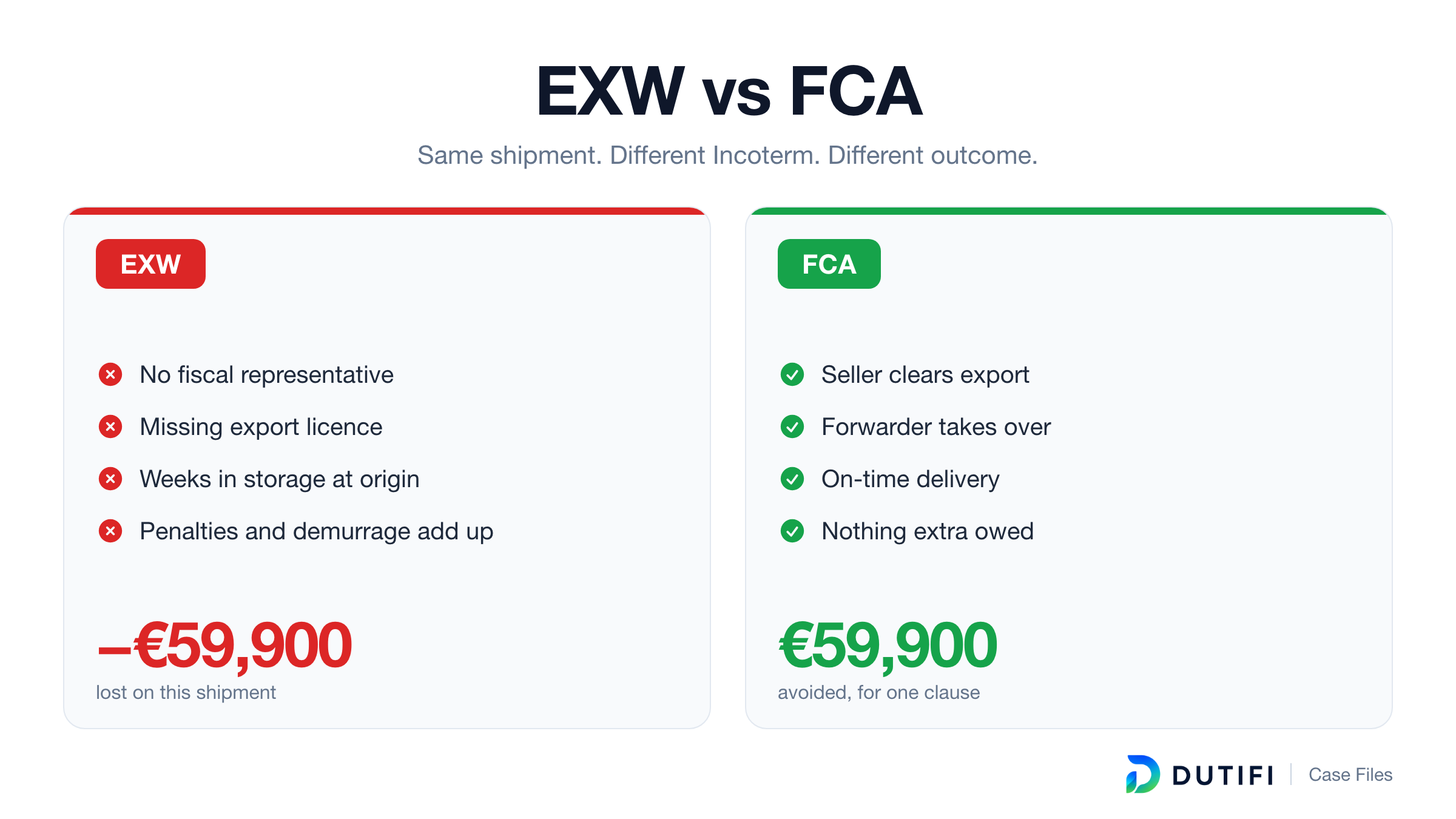
A buyer nearly lost €59,900 on a single shipment by agreeing to EXW, which made them responsible for export clearance in a country where they had no presence.
Picture a growing EU retailer importing packaging equipment from an overseas manufacturer for the first time. Invoice value is a little over €240,000. The retailer asks for Ex Works, because it looks like the cheapest line on the quote and because doing everything themselves sounds like control.
What EXW actually obliged them to do
Under EXW, the seller has one job. They make the goods available at their own premises, and that is where their responsibility stops. Everything after that belongs to the buyer. Loading, inland haulage, and the part almost nobody prices in: the export declaration in the seller’s country.
That last one is the trap. An export declaration is not paperwork you can file from another country on a laptop. In most jurisdictions it has to be lodged by a party established there, using local credentials, against a local customs system. Our retailer had no fiscal representative in the country of dispatch, no relationship with a local broker, and no working knowledge of how the export process ran there.
So the goods would have been ready, paid for, and stuck. Sitting at origin, accruing charges, while somebody scrambled to appoint a broker who could lodge a declaration correctly at short notice. A rushed declaration is also a wrong declaration more often than not, which is where the largest number on this page comes from.
There is a second problem that surfaces later, and it catches sellers rather than buyers. When the buyer controls the export declaration, the seller is the one who has to evidence that the goods actually left the country in order to zero-rate the sale. Under EXW they are relying on a counterparty they have no control over to hand back proof they never see. Sellers who have been stung by this once tend to refuse EXW afterwards, which is worth knowing if you are the buyer asking for it and cannot understand the resistance.
Here is what that adds up to on one shipment.
| Line item | Cost |
|---|---|
| Storage and demurrage at the origin port | €6,100 |
| Penalty for an incorrect export declaration | €31,200 |
| Emergency customs broker and rushed export licence | €9,800 |
| Late-delivery penalty owed to their own customer | €12,800 |
| Total | €59,900 |
Figures are representative composites based on typical published charges and penalty ranges, not data from a specific client. Actual costs vary by jurisdiction, carrier and case. Full disclaimer.
The penalty line deserves a note, because it is the most variable figure here and the one worth checking against your own corridor. Export penalties are set nationally, not at EU level. Depending on the country they run from a fixed administrative fine in the low hundreds to a percentage of the value of the goods, and they escalate sharply when a declaration is wrong rather than merely late. The figure above sits at the serious end of that range. In a different jurisdiction, on the same facts, it could be a tenth of that. It could also be more.
What the alternative cost
The buyer’s logistics lead flagged the clause before signature and pushed for FCA instead.
Under FCA, the seller handles export clearance. They are local, they are registered, they file declarations in that country every week. The buyer’s own freight forwarder collects the goods once they are cleared and runs the rest of the journey, which is the part the buyer is genuinely equipped for.
Same goods. Same seller. Same route. Same price for the equipment. The cost of the change was one clause and one conversation before anybody signed anything.
The lesson
An Incoterm is not a pricing lever. It is an allocation of work, and the work does not disappear because you accepted it. Whoever takes on a leg has to be able to perform it in the country where it happens, with the registrations and relationships that requires.
EXW is not automatically the cheapest option, and FCA is not the weaker deal. EXW only makes sense when the buyer can genuinely deliver on the export side. FCA just puts the paperwork with whoever is already set up to file it. The question to ask before signing is not which term looks cheapest on the quote. It is whether the party taking on the term can actually carry it.
If you want to pressure-test a term before it goes into a contract, the Incoterm Advisor works through the responsibilities on your specific route and tells you where cost and risk change hands.
Has anyone here seen a shipment nearly stall at origin because an EXW call was made too quickly? What did it end up costing?